
Join Our JEE Preparation Group
Prep with like-minded aspirants; Get access to free daily tests and study material.
Sign in
Please select an account to continue using cracku.in
↓ →
Join Our JEE Preparation Group
Prep with like-minded aspirants; Get access to free daily tests and study material.
We need to determine the local maxima and minima of $$f(x) = 2x + 3x^{2/3}$$ for $$x \in \mathbb{R}$$.
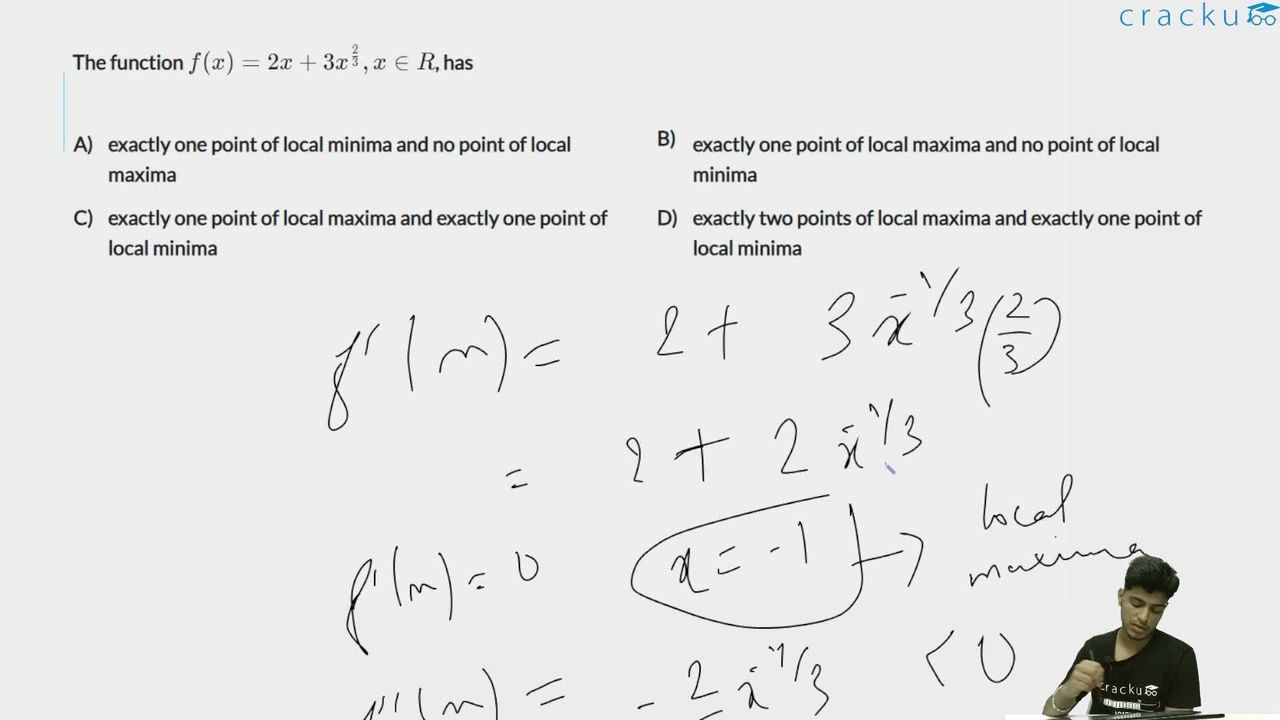
$$f'(x) = 2 + 3 \cdot \frac{2}{3}\, x^{-1/3} = 2 + \frac{2}{x^{1/3}}$$
This can be written as:
$$f'(x) = \frac{2x^{1/3} + 2}{x^{1/3}} = \frac{2(x^{1/3} + 1)}{x^{1/3}}$$
Critical points occur where $$f'(x) = 0$$ or $$f'(x)$$ is undefined.
Case 1: $$f'(x) = 0$$: The numerator $$2(x^{1/3} + 1) = 0 \implies x^{1/3} = -1 \implies x = -1$$.
Case 2: $$f'(x)$$ undefined: The denominator $$x^{1/3} = 0 \implies x = 0$$.
So the critical points are $$x = -1$$ and $$x = 0$$.
| Interval | $$x^{1/3}$$ | $$x^{1/3}\!+\!1$$ | $$f'(x)$$ | Trend |
|---|---|---|---|---|
| $$x < -1$$ | $$< -1$$ | $$< 0$$ | $$+ve$$ | Increasing |
| $$-1 < x < 0$$ | $$(-1, 0)$$ | $$> 0$$ | $$-ve$$ | Decreasing |
| $$x > 0$$ | $$> 0$$ | $$> 0$$ | $$+ve$$ | Increasing |
At $$x = -1$$: $$f'(x)$$ changes from $$+ve$$ to $$-ve$$ → local maximum.
$$f(-1) = 2(-1) + 3(-1)^{2/3} = -2 + 3(1) = 1$$
At $$x = 0$$: $$f'(x)$$ changes from $$-ve$$ to $$+ve$$ → local minimum.
$$f(0) = 0$$
Conclusion: The function has exactly one point of local maxima (at $$x = -1$$) and exactly one point of local minima (at $$x = 0$$).
The answer is Option C: exactly one local maxima and exactly one local minima.
Was this solution helpful?
Click on the Email ☝️ to Watch the Video Solution
Create a FREE account and get:
_1.webp)

Educational materials for JEE preparation

Ask our AI anything

AI can make mistakes. Please verify important information.
AI can make mistakes. Please verify important information.
