
Join Our JEE Preparation Group
Prep with like-minded aspirants; Get access to free daily tests and study material.
Sign in
Please select an account to continue using cracku.in
↓ →
Join Our JEE Preparation Group
Prep with like-minded aspirants; Get access to free daily tests and study material.
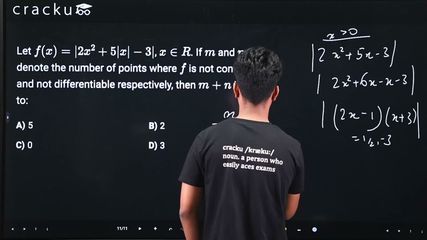
Let $$f(x) = |2x^2 + 5|x| - 3|$$, $$x \in R$$. If $$m$$ and $$n$$ denote the number of points where $$f$$ is not continuous and not differentiable respectively, then $$m + n$$ is equal to:
Continuity (m): The function is a composition of absolute value and polynomials, which are continuous everywhere. Thus, $$m = 0$$.
Differentiability (n): Let $$g(x) = 2x^2 + 5|x| - 3$$.
o At $$x = 0$$: $$5|x|$$ creates a sharp corner. Since the derivative of $$2x^2-3$$ is 0 at x=0, the non-differentiability of |x| at 0 makes f(x) non-differentiable at x = 0.
o At roots of $$g(x) = 0$$:
For $$x\ge 0$$: $$2x^2 + 5x - 3 = 0 \implies (2x - 1)(x + 3) = 0 \implies x = 1/2$$ (Since $$x \ge 0$$).
For $$x < 0$$: $$2x^2 - 5x - 3 = 0 \implies (2x + 1)(x - 3) = 0 \implies x = -1/2$$ (Since x < 0).
The outer absolute value $$|\cdot|$$ creates sharp corners at $$x = 1/2$$ and $$x = -1/2$$.
Total points of non-differentiability $$n = 3$$ (at $$x = 0, \pm 1/2$$).
$$m + n = 0 + 3 = 3$$.
Correct Option: D
Was this solution helpful?
Click on the Email ☝️ to Watch the Video Solution
Create a FREE account and get:
_1.webp)

Educational materials for JEE preparation

Ask our AI anything

AI can make mistakes. Please verify important information.
AI can make mistakes. Please verify important information.
