
Join Our JEE Preparation Group
Prep with like-minded aspirants; Get access to free daily tests and study material.
Sign in
Please select an account to continue using cracku.in
↓ →
Join Our JEE Preparation Group
Prep with like-minded aspirants; Get access to free daily tests and study material.
If $$y = \sum_{k=1}^{6} k\cos^{-1}\left\{\frac{3}{5}\cos kx - \frac{4}{5}\sin kx\right\}$$ then $$\frac{dy}{dx}$$ at $$x = 0$$ is ___________.
Correct Answer: 91
We have to differentiate the function
$$y=\sum_{k=1}^{6}k\,\cos^{-1}\!\Bigg\{\frac35\cos kx-\frac45\sin kx\Bigg\}$$
and then evaluate $$\dfrac{dy}{dx}$$ at $$x=0$$.
First we inspect the expression inside the inverse cosine. Write
$$A_k(x)=\frac35\cos kx-\frac45\sin kx.$$
Notice that the numerical coefficients satisfy
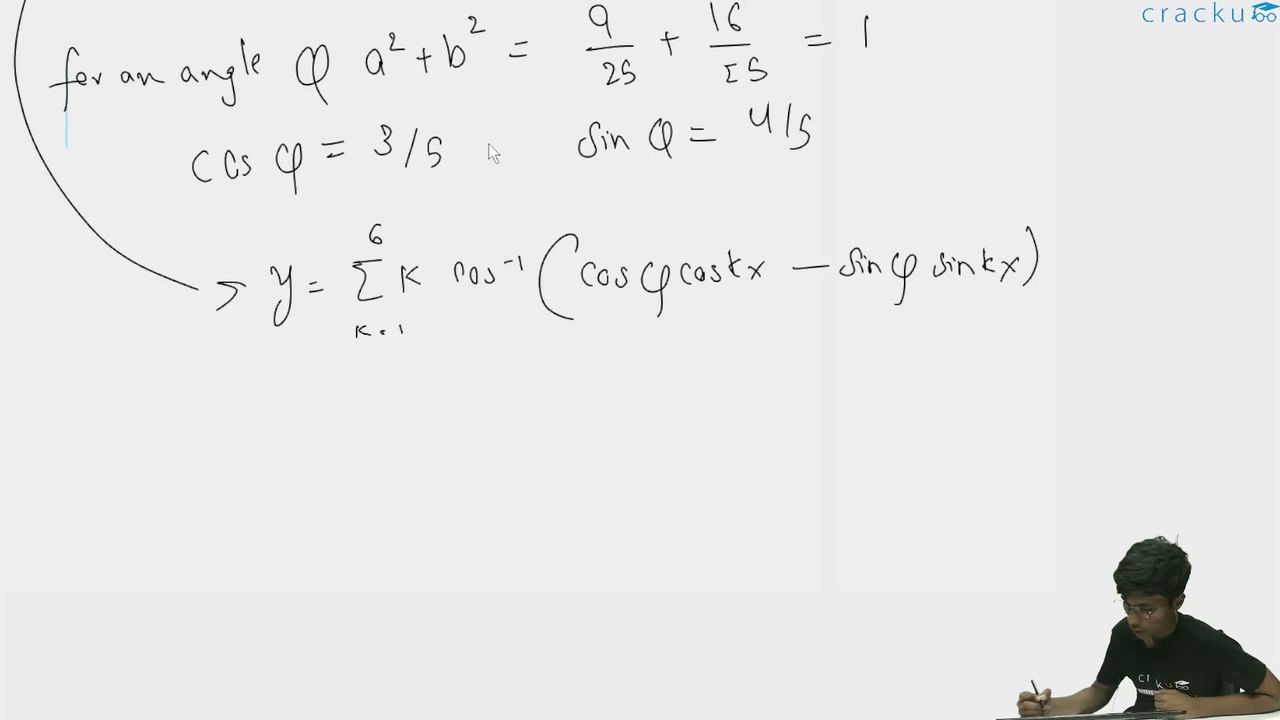
$$\left(\frac35\right)^{\!2}+\left(\frac45\right)^{\!2}=\frac{9}{25}+\frac{16}{25}=1.$$
Because the sum of squares is $$1,$$ the pair $$\left(\frac35,-\frac45\right)$$ can be interpreted as $$\bigl(\cos\varphi,-\sin\varphi\bigr)$$ for some angle $$\varphi$$ lying in the first quadrant. Indeed, choose $$\varphi$$ such that
$$\cos\varphi=\frac35,\qquad\sin\varphi=\frac45.$$
Now use the standard identity
$$\cos(\alpha+\beta)=\cos\alpha\cos\beta-\sin\alpha\sin\beta.$$
Putting $$\alpha=kx$$ and $$\beta=\varphi,$$ we get
$$\cos(kx+\varphi)=\cos kx\cos\varphi-\sin kx\sin\varphi =\frac35\cos kx-\frac45\sin kx =A_k(x).$$
So we have shown
$$A_k(x)=\cos(kx+\varphi)\quad\text{where}\quad\cos\varphi=\frac35,\ \sin\varphi=\frac45.$$
Hence the given sum becomes
$$y=\sum_{k=1}^{6}k\,\cos^{-1}\!\Bigl(\cos(kx+\varphi)\Bigr).$$
For the principal value of $$\cos^{-1}(\cdot),$$ the range is $$[0,\pi].$$ The fixed angle $$\varphi$$ equals $$\cos^{-1}\!\frac35\approx0.927\,\text{rad},$$ which lies strictly between $$0$$ and $$\pi.$$ When $$x$$ is very close to $$0$$, each argument $$kx+\varphi$$ also remains in the interval $$\bigl(0,\pi\bigr).$$ Therefore, for sufficiently small $$x$$ (including the point $$x=0$$ itself) we may legitimately use
$$\cos^{-1}\bigl(\cos\theta\bigr)=\theta\quad\text{whenever}\quad 0\le\theta\le\pi.$$
Applying this to every term, we get in a neighbourhood of $$x=0$$
$$\cos^{-1}\!\Bigl(\cos(kx+\varphi)\Bigr)=kx+\varphi.$$
Consequently,
$$y=\sum_{k=1}^{6}k\,(kx+\varphi)=\sum_{k=1}^{6}\bigl(k^{2}x+k\varphi\bigr) =\Bigl(\sum_{k=1}^{6}k^{2}\Bigr)x+\Bigl(\sum_{k=1}^{6}k\Bigr)\varphi.$$
Differentiate term by term with respect to $$x$$. The constant parts involving $$\varphi$$ vanish, leaving
$$\frac{dy}{dx}=\sum_{k=1}^{6}k^{2}.$$
Now evaluate the simple finite sum of squares:
$$\sum_{k=1}^{6}k^{2}=1^{2}+2^{2}+3^{2}+4^{2}+5^{2}+6^{2} =1+4+9+16+25+36=91.$$
Finally, substitute $$x=0$$ (though the derivative is already independent of $$x$$ in the chosen neighbourhood):
$$\left.\frac{dy}{dx}\right|_{x=0}=91.$$
Hence, the correct answer is Option A, $$91$$.
Was this solution helpful?
Click on the Email ☝️ to Watch the Video Solution
Create a FREE account and get:
_1.webp)

Educational materials for JEE preparation

Ask our AI anything

AI can make mistakes. Please verify important information.
AI can make mistakes. Please verify important information.


