
Join Our JEE Preparation Group
Prep with like-minded aspirants; Get access to free daily tests and study material.
Sign in
Please select an account to continue using cracku.in
↓ →
Join Our JEE Preparation Group
Prep with like-minded aspirants; Get access to free daily tests and study material.
Consider a cuboid of sides $$2x, 4x$$ and $$5x$$ and a closed hemisphere of radius $$r$$. If the sum of their surface areas is constant $$k$$, then the ratio $$x : r$$, for which the sum of their volumes is maximum, is
We need to find the ratio $$x : r$$ that maximizes the sum of volumes of a cuboid with sides $$2x, 4x, 5x$$ and a closed hemisphere of radius $$r$$, given that the sum of their surface areas is a constant $$k$$.
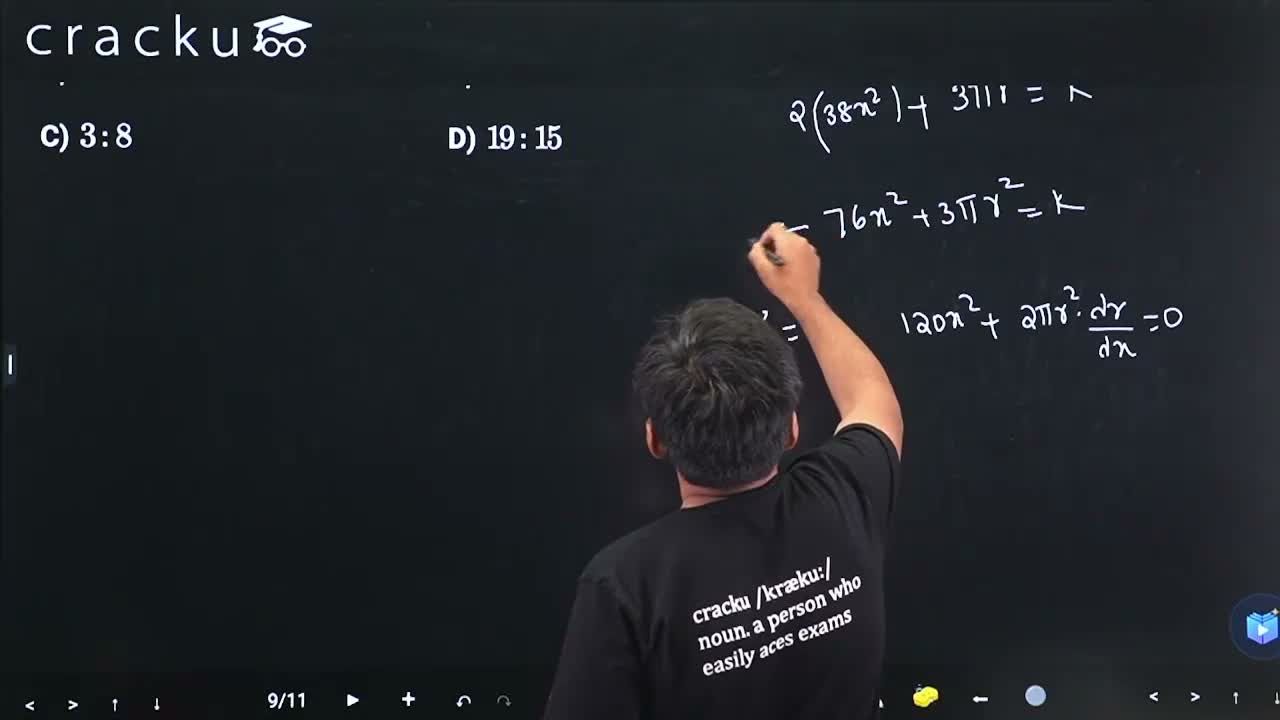
First, we write the surface area constraint. The surface area of the cuboid is $$2(2x \cdot 4x + 4x \cdot 5x + 2x \cdot 5x) = 2(8x^2 + 20x^2 + 10x^2) = 76x^2$$, and the surface area of the closed hemisphere (curved surface + flat circular base) is $$2\pi r^2 + \pi r^2 = 3\pi r^2$$. Since the total surface area is constant, we have $$76x^2 + 3\pi r^2 = k$$.
Next, we write the total volume. The volume of the cuboid is $$2x \cdot 4x \cdot 5x$$, and the volume of the hemisphere is $$\frac{2}{3}\pi r^3$$, so that the combined volume is $$V = 40x^3 + \frac{2}{3}\pi r^3$$.
Now, we differentiate the constraint with respect to $$x$$ in order to relate $$\frac{dr}{dx}$$. Differentiating $$76x^2 + 3\pi r^2 = k$$ gives $$152x + 6\pi r \frac{dr}{dx} = 0$$, which implies $$\frac{dr}{dx} = -\frac{152x}{6\pi r} = -\frac{76x}{3\pi r}$$.
Then, we set $$\frac{dV}{dx} = 0$$ for maximum volume. Since $$\frac{dV}{dx} = 120x^2 + 2\pi r^2 \cdot \frac{dr}{dx}$$, substituting the expression for $$\frac{dr}{dx}$$ yields $$120x^2 + 2\pi r^2 \left(-\frac{76x}{3\pi r}\right) = 0$$, which simplifies to $$120x^2 - \frac{152xr}{3} = 0$$. Therefore, $$120x = \frac{152r}{3}$$, so that $$360x = 152r$$ and hence $$\frac{x}{r} = \frac{152}{360} = \frac{19}{45}$$.
Subsequently, we conclude that $$x : r = 19 : 45$$, and thus the answer is Option B: $$19 : 45$$.
Was this solution helpful?
Click on the Email ☝️ to Watch the Video Solution
Create a FREE account and get:
_1.webp)

Educational materials for JEE preparation

Ask our AI anything

AI can make mistakes. Please verify important information.
AI can make mistakes. Please verify important information.
