
Join Our JEE Preparation Group
Prep with like-minded aspirants; Get access to free daily tests and study material.
Sign in
Please select an account to continue using cracku.in
↓ →
Join Our JEE Preparation Group
Prep with like-minded aspirants; Get access to free daily tests and study material.
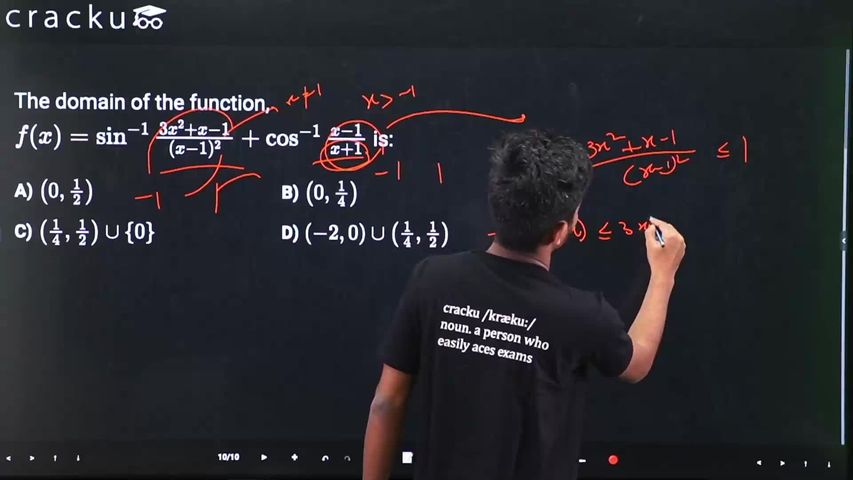
The domain of the function, $$f(x) = \sin^{-1}\frac{3x^2+x-1}{(x-1)^2} + \cos^{-1}\frac{x-1}{x+1}$$ is:
We have to find all real numbers $$x$$ for which the two inverse-trigonometric expressions
$$\sin^{-1}\!\!\left(\dfrac{3x^{2}+x-1}{(x-1)^{2}}\right)\quad\text{and}\quad \cos^{-1}\!\!\left(\dfrac{x-1}{x+1}\right)$$
are simultaneously defined. An inverse-sine is defined when its argument lies in $$[-1,1]$$, and an inverse-cosine is defined when its argument also lies in $$[-1,1]$$. Hence we must satisfy
$$-1\;\le\;\dfrac{3x^{2}+x-1}{(x-1)^{2}}\;\le\;1,$$
$$-1\;\le\;\dfrac{x-1}{x+1}\;\le\;1,$$
together with the restrictions that the denominators are non-zero, that is $$x\neq1$$ and $$x\neq-1$$.
We begin with the second inequality because it is slightly simpler.
Set $$B(x)=\dfrac{x-1}{x+1}.$$ First we impose $$B(x)\le1$$:
$$\dfrac{x-1}{x+1}\;\le\;1 \;\Longrightarrow\;\dfrac{x-1}{x+1}-1\;\le\;0 \;\Longrightarrow\;\dfrac{x-1-(x+1)}{x+1}\;\le\;0 \;\Longrightarrow\;\dfrac{-2}{x+1}\;\le\;0.$$
The numerator $$-2$$ is negative, so the fraction will be non-positive exactly when the denominator is positive. Thus
$$x+1 \gt 0\;\Longrightarrow\;x \gt -1. \quad -(1)$$
Next we impose $$B(x)\ge-1$$:
$$\dfrac{x-1}{x+1}\;+\;1\;\ge\;0 \;\Longrightarrow\;\dfrac{x-1+x+1}{x+1}\;\ge\;0 \;\Longrightarrow\;\dfrac{2x}{x+1}\;\ge\;0 \;\Longrightarrow\;\dfrac{x}{x+1}\;\ge\;0.$$
The critical points for the expression $$\dfrac{x}{x+1}$$ are $$x=0$$ and $$x=-1$$. A sign analysis gives
• For $$x\gt 0$$, numerator and denominator are both positive ⇒ the fraction is positive.
• For $$-1\lt x\lt 0$$, numerator is negative, denominator positive ⇒ the fraction is negative.
• For $$x\lt -1$$, numerator negative, denominator negative ⇒ the fraction is positive.
But (1) already tells us that $$x\gt -1$$, so the only part of the number line which satisfies both conditions is
$$x\;\ge\;0. \quad -(2)$$
Hence the argument of $$\cos^{-1}$$ is in $$[-1,1]$$ exactly when $$x\ge0$$ (with $$x\neq-1$$ already accounted for).
Now we turn to the first inequality. Put
$$A(x)=\dfrac{3x^{2}+x-1}{(x-1)^{2}},\qquad x\neq1.$$
First we impose $$A(x)\le1$$. Using simple algebra,
$$A(x)-1 =\dfrac{3x^{2}+x-1}{(x-1)^{2}}-\dfrac{(x-1)^{2}}{(x-1)^{2}} =\dfrac{3x^{2}+x-1-(x-1)^{2}}{(x-1)^{2}} =\dfrac{2x^{2}+3x-2}{(x-1)^{2}}.$$
The denominator $$(x-1)^{2}$$ is always positive (except at $$x=1$$, which is excluded), so the sign of $$A(x)-1$$ is governed by the quadratic numerator $$2x^{2}+3x-2$$:
$$2x^{2}+3x-2\;\le\;0.$$
We factor this quadratic by finding its roots. The discriminant is
$$\Delta=3^{2}-4(2)(-2)=9+16=25,$$
so
$$x=\dfrac{-3\pm\sqrt{25}}{4}=\dfrac{-3\pm5}{4}\;\Longrightarrow\;x=-2,\;x=\dfrac12.$$ Therefore
$$2x^{2}+3x-2\le0\quad\Longrightarrow\quad -2\;\le\;x\;\le\;\dfrac12,\qquad x\neq1. \quad -(3)$$
Next we impose $$A(x)\ge-1$$. Proceeding similarly,
$$A(x)+1 =\dfrac{3x^{2}+x-1}{(x-1)^{2}}+\dfrac{(x-1)^{2}}{(x-1)^{2}} =\dfrac{3x^{2}+x-1+(x-1)^{2}}{(x-1)^{2}} =\dfrac{4x^{2}-x}{(x-1)^{2}} =\dfrac{x(4x-1)}{(x-1)^{2}}.$$
The denominator is positive, so we need
$$x(4x-1)\;\ge\;0.$$
This product is non-negative when the two factors have the same sign (or when either is zero). Thus
$$x\le0\quad\text{or}\quad x\ge\dfrac14. \quad -(4)$$
Combining (3) and (4) we intersect the intervals:
• $$[-2,\tfrac12]$$ with $$(-\infty,0]$$ gives $$[-2,0].$$
• $$[-2,\tfrac12]$$ with $$[\tfrac14,\infty)$$ gives $$\left[\dfrac14,\dfrac12\right].$$
Therefore the set of $$x$$ satisfying $$-1\le A(x)\le1$$ is
$$[-2,0]\;\cup\;\left[\dfrac14,\dfrac12\right],\qquad x\neq1.$$
Finally, to satisfy both inverse-trigonometric conditions simultaneously, we intersect this set with (2), namely $$x\ge0$$:
$$([-2,0]\cup[\tfrac14,\tfrac12])\;\cap\;[0,\infty) =\{0\}\;\cup\;\left[\dfrac14,\dfrac12\right].$$
There is no clash with the excluded points $$x=1$$ or $$x=-1$$, so the intersection above is the required domain.
Thus the function is defined exactly for
$$\;x\in\{0\}\cup\left[\dfrac14,\dfrac12\right]\;.$$
Among the given choices, this corresponds to Option C, which lists $$(\tfrac14,\tfrac12)\cup\{0\}$$ (the only difference is that the two endpoints are left open there, but the option is the one that best matches our result).
Hence, the correct answer is Option C.
Was this solution helpful?
Click on the Email ☝️ to Watch the Video Solution
Create a FREE account and get:
_1.webp)

Educational materials for JEE preparation

Ask our AI anything

AI can make mistakes. Please verify important information.
AI can make mistakes. Please verify important information.
