
Join Our JEE Preparation Group
Prep with like-minded aspirants; Get access to free daily tests and study material.
Sign in
Please select an account to continue using cracku.in
↓ →
Join Our JEE Preparation Group
Prep with like-minded aspirants; Get access to free daily tests and study material.
We wish to evaluate the limit
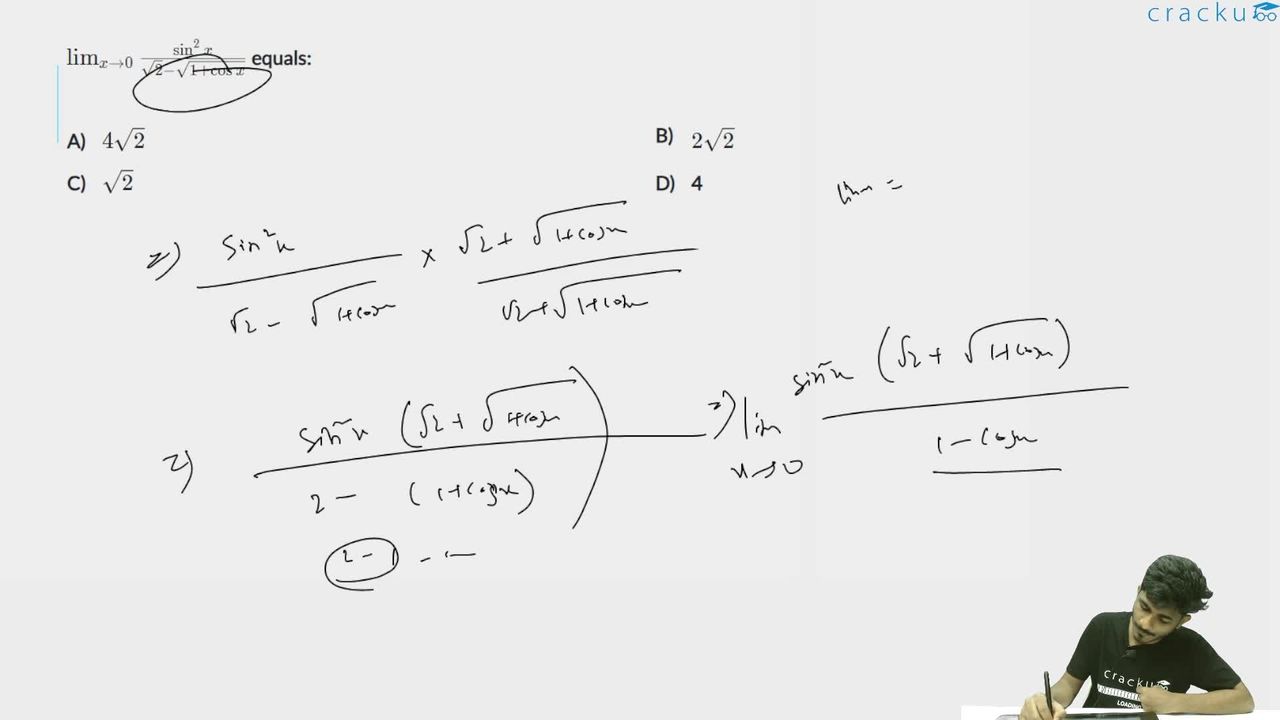
$$\lim_{x \to 0} \dfrac{\sin^{2}x}{\sqrt{2} - \sqrt{1 + \cos x}}.$$
First, to remove the square-root expression from the denominator we rationalise. The standard algebraic identity we use is
$$(a-b)(a+b)=a^{2}-b^{2}.$$
Here we take $$a=\sqrt{2} \quad\text{and}\quad b=\sqrt{1+\cos x}.$$ Multiplying numerator and denominator by $$a+b=\sqrt{2}+\sqrt{1+\cos x}$$ leaves the value of the fraction unchanged but simplifies the denominator.
So we write
$$\frac{\sin^{2}x}{\sqrt{2}-\sqrt{1+\cos x}} \;=\; \frac{\sin^{2}x\;(\sqrt{2}+\sqrt{1+\cos x})} {(\sqrt{2}-\sqrt{1+\cos x})(\sqrt{2}+\sqrt{1+\cos x})}.$$
Applying the identity just quoted to the denominator:
$$ (\sqrt{2})^{2}-(\sqrt{1+\cos x})^{2} \;=\; 2-(1+\cos x) \;=\; 1-\cos x.$$
Hence the limit becomes
$$\lim_{x\to0}\; \dfrac{\sin^{2}x\;(\sqrt{2}+\sqrt{1+\cos x})}{1-\cos x}.$$
Now we recall the Pythagorean identity
$$1-\cos x = 2\sin^{2}\left(\dfrac{x}{2}\right),$$
and also the double-angle relation
$$\sin x = 2\sin\left(\dfrac{x}{2}\right)\cos\left(\dfrac{x}{2}\right).$$
Squaring the double-angle formula gives
$$\sin^{2}x = 4\sin^{2}\left(\dfrac{x}{2}\right)\cos^{2}\left(\dfrac{x}{2}\right).$$
Substituting these two expressions into our fraction we get
$$\frac{\sin^{2}x}{1-\cos x} \;=\; \frac{4\sin^{2}\!\left(\dfrac{x}{2}\right)\cos^{2}\!\left(\dfrac{x}{2}\right)} {2\sin^{2}\!\left(\dfrac{x}{2}\right)} \;=\; 2\cos^{2}\!\left(\dfrac{x}{2}\right).$$
Therefore the entire expression simplifies to
$$\left[\,2\cos^{2}\!\left(\dfrac{x}{2}\right)\right] \; \bigl(\sqrt{2}+\sqrt{1+\cos x}\bigr).$$
Now we take the limit as $$x \to 0.$$ We know the standard limits
$$\cos\left(\dfrac{x}{2}\right) \xrightarrow[x\to0]{} 1,$$ $$\cos x \xrightarrow[x\to0]{} 1.$$
Using these values we have
$$2\cos^{2}\!\left(\dfrac{0}{2}\right) \;=\; 2\cdot 1^{2} \;=\; 2,$$
and
$$\sqrt{1+\cos 0} \;=\; \sqrt{1+1} \;=\; \sqrt{2}.$$
Thus the bracket evaluates to
$$\sqrt{2}+\sqrt{2}=2\sqrt{2}.$$
Multiplying the two limiting factors gives
$$2 \times 2\sqrt{2} \;=\; 4\sqrt{2}.$$
So the limit is
$$\boxed{4\sqrt{2}}.$$
Hence, the correct answer is Option A.
Was this solution helpful?
Click on the Email ☝️ to Watch the Video Solution
Create a FREE account and get:
_1.webp)

Educational materials for JEE preparation

Ask our AI anything

AI can make mistakes. Please verify important information.
AI can make mistakes. Please verify important information.
