
Join Our JEE Preparation Group
Prep with like-minded aspirants; Get access to free daily tests and study material.
Sign in
Please select an account to continue using cracku.in
↓ →
Join Our JEE Preparation Group
Prep with like-minded aspirants; Get access to free daily tests and study material.
The reaction of $$NaBH_4$$ with iodine produces $$BI_3$$ according to the following equation:
$$NaBH_4+4I_2\rightarrow BI_3+NaI+4HI$$
If $$37.8g$$ of $$NaBH_4$$ reacts with excess iodine and produces $$39.18g$$ of $$BI_3$$, calculate the percentage yield of $$BI_3$$.
Given atomic masses: $$Na=23,\ B=10.8,\ I=127$$
Enter the answer as the nearest integer.
Correct Answer: 10
1. Calculate Molar Masses
a) Molar mass of $$\mathrm{NaBH_4}$$:
$$23+10.8+(4\times1)=37.8\,\mathrm{g\,mol^{-1}}$$
b) Molar mass of $$\mathrm{BI_3}$$:
$$10.8+(3\times127)=391.8\,\mathrm{g\,mol^{-1}}$$
2. Determine Theoretical Yield
a) Moles of $$\mathrm{NaBH_4}$$ reacted:
$$n=\frac{37.8\,\mathrm{g}}{37.8\,\mathrm{g\,mol^{-1}}}=1\,\mathrm{mol}$$
b) According to the balanced chemical equation, 1 mole of $$\mathrm{NaBH_4}$$ produces 1 mole of $$\mathrm{BI_3}$$.
c) Theoretical mass of $$\mathrm{BI_3}$$ produced:
$$m=1\times391.8=391.8\,\mathrm{g}$$
3. Calculate Percentage Yield
a) Using the percentage yield formula:
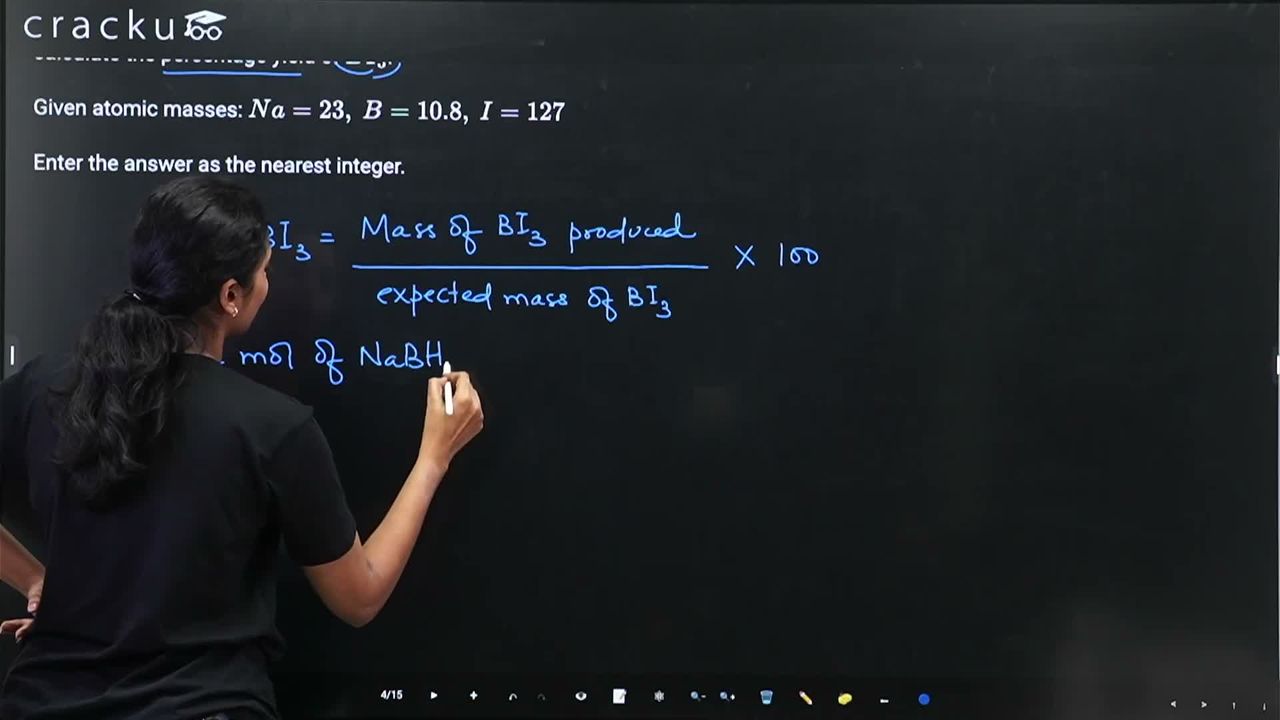
$$\mathrm{Percentage\ Yield}=\frac{\mathrm{Actual\ Yield}}{\mathrm{Theoretical\ Yield}}\times100$$
b) Substituting the values:
$$\mathrm{Percentage\ Yield}=\frac{39.18}{391.8}\times100$$
$$\boxed{\mathrm{Percentage\ Yield}=10\%}$$
Correct answer: 10
Was this solution helpful?
Click on the Email ☝️ to Watch the Video Solution
Create a FREE account and get:
_1.webp)

Educational materials for JEE preparation

Ask our AI anything

AI can make mistakes. Please verify important information.
AI can make mistakes. Please verify important information.
