
Join Our JEE Preparation Group
Prep with like-minded aspirants; Get access to free daily tests and study material.
Sign in
Please select an account to continue using cracku.in
↓ →
Join Our JEE Preparation Group
Prep with like-minded aspirants; Get access to free daily tests and study material.
Out of all the patients in a hospital 89% are found to be suffering from heart ailment and 98% are suffering from lungs infection. If $$K$$% of them are suffering from both ailments, then $$K$$ can not belong to the set:
Let us denote by $$H$$ the set of patients having a heart ailment and by $$L$$ the set of patients having a lung infection.
We are told that $$P(H)=89\%$$ and $$P(L)=98\%$$, where $$P(\cdot)$$ represents the percentage of the total number of patients.
For two sets, the Inclusion-Exclusion Principle states first:
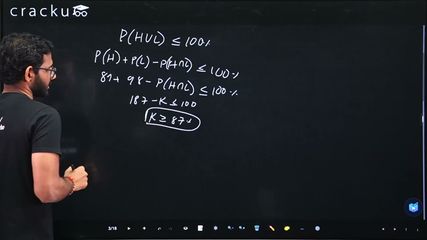
$$P(H\cup L)=P(H)+P(L)-P(H\cap L).$$
Secondly, because a percentage cannot exceed the whole, we have the bound:
$$P(H\cup L)\le 100\%.$$
Combining these two facts, we write
$$P(H)+P(L)-P(H\cap L)\le 100.$$
Substituting the given values,
$$89+98-K\le 100,$$
where $$K$$ is exactly $$P(H\cap L)$$, the percentage suffering from both ailments.
Now we simplify step by step:
$$187-K\le 100,$$
so
$$-K\le 100-187,$$
hence
$$-K\le -87,$$
and multiplying both sides by $$-1$$ (remembering to reverse the inequality sign) we obtain
$$K\ge 87.$$
Next, we recall another elementary bound: the intersection of two sets can never exceed either of the individual sets. Symbolically,
$$P(H\cap L)\le \min\{P(H),P(L)\}.$$
Because $$P(H)=89\%$$ and $$P(L)=98\%,$$ the smaller of the two is $$89\%,$$ so
$$K\le 89.$$
Putting the two inequalities together, we get the precise interval
$$87\le K\le 89.$$
Thus the only possible integral values of $$K$$ are $$87, 88, 89.$$ Any value outside this closed interval is impossible.
Now we inspect each given option:
Option A: $$\{79,81,83,85\}$$ - none of these values lie in $$[87,89].$$
Option B: $$\{84,87,90,93\}$$ - the element $$87$$ does lie in $$[87,89].$$
Option C: $$\{80,83,86,89\}$$ - the element $$89$$ does lie in $$[87,89].$$
Option D: $$\{84,86,88,90\}$$ - the element $$88$$ does lie in $$[87,89].$$
Therefore, the only set in which $$K$$ cannot possibly fall is Option A.
Hence, the correct answer is Option A.
Was this solution helpful?
Click on the Email ☝️ to Watch the Video Solution
Create a FREE account and get:
_1.webp)

Educational materials for JEE preparation

Ask our AI anything

AI can make mistakes. Please verify important information.
AI can make mistakes. Please verify important information.
