
Join Our JEE Preparation Group
Prep with like-minded aspirants; Get access to free daily tests and study material.
Sign in
Please select an account to continue using cracku.in
↓ →
Join Our JEE Preparation Group
Prep with like-minded aspirants; Get access to free daily tests and study material.
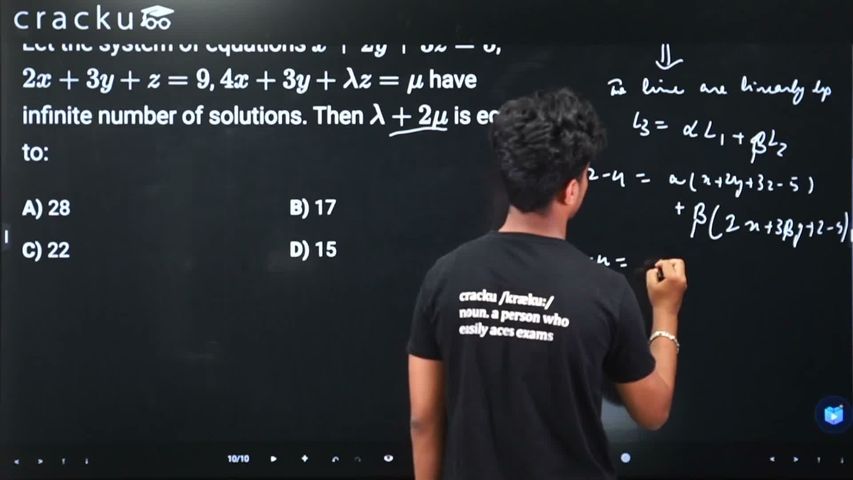
Let the system of equations $$x + 2y + 3z = 5$$, $$2x + 3y + z = 9$$, $$4x + 3y + \lambda z = \mu$$ have infinite number of solutions. Then $$\lambda + 2\mu$$ is equal to:
We need to find $$\lambda + 2\mu$$ such that the system $$x + 2y + 3z = 5$$, $$2x + 3y + z = 9$$, $$4x + 3y + \lambda z = \mu$$ has infinitely many solutions.
For a system of 3 equations in 3 unknowns to have infinitely many solutions, the third equation must be a linear combination of the first two, AND the determinant of the coefficient matrix must be zero.
Let the third equation = $$\alpha$$ (Eq 1) + $$\beta$$ (Eq 2):
$$\alpha(x + 2y + 3z) + \beta(2x + 3y + z) = \alpha \cdot 5 + \beta \cdot 9$$
$$(\alpha + 2\beta)x + (2\alpha + 3\beta)y + (3\alpha + \beta)z = 5\alpha + 9\beta$$
Comparing with $$4x + 3y + \lambda z = \mu$$:
$$\alpha + 2\beta = 4$$ ... (i)
$$2\alpha + 3\beta = 3$$ ... (ii)
$$3\alpha + \beta = \lambda$$ ... (iii)
$$5\alpha + 9\beta = \mu$$ ... (iv)
From (i): $$\alpha = 4 - 2\beta$$.
Substitute into (ii): $$2(4 - 2\beta) + 3\beta = 3 \implies 8 - 4\beta + 3\beta = 3 \implies \beta = 5$$.
So $$\alpha = 4 - 10 = -6$$.
$$\lambda = 3(-6) + 5 = -18 + 5 = -13$$
$$\mu = 5(-6) + 9(5) = -30 + 45 = 15$$
$$\lambda + 2\mu = -13 + 2(15) = -13 + 30 = 17$$
The correct answer is 17 (Option B).
Was this solution helpful?
Click on the Email ☝️ to Watch the Video Solution
Create a FREE account and get:
_1.webp)

Educational materials for JEE preparation

Ask our AI anything

AI can make mistakes. Please verify important information.
AI can make mistakes. Please verify important information.
