
Join Our JEE Preparation Group
Prep with like-minded aspirants; Get access to free daily tests and study material.
Sign in
Please select an account to continue using cracku.in
↓ →
Join Our JEE Preparation Group
Prep with like-minded aspirants; Get access to free daily tests and study material.
If the mean deviation about median for the numbers $$3, 5, 7, 2k, 12, 16, 21, 24$$ arranged in the ascending order, is $$6$$ then the median is
We need to find the median of the data $$3, 5, 7, 2k, 12, 16, 21, 24$$ given that the mean deviation about the median is 6.
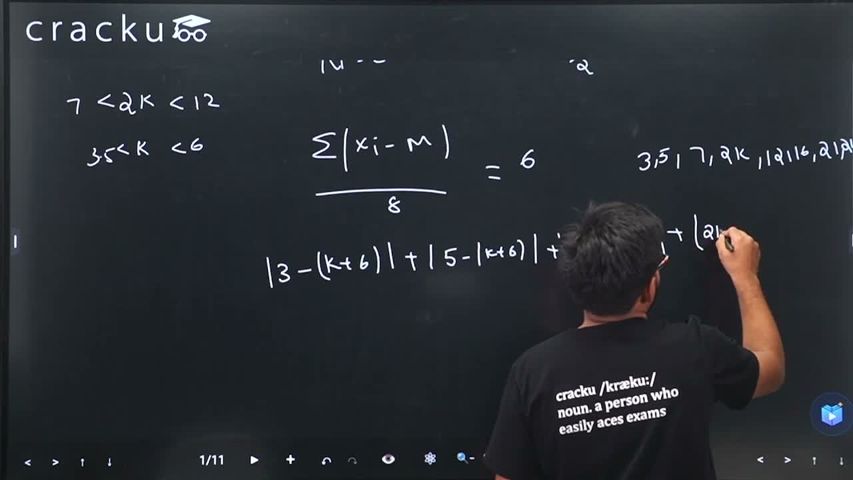
Since the data is in ascending order, we have $$7 \leq 2k \leq 12$$, which implies $$3.5 \leq k \leq 6$$.
For eight observations, the median is the average of the 4th and 5th values, so
$$M = \dfrac{2k + 12}{2} = k + 6$$
The mean deviation about the median is defined by
$$\text{M.D.} = \dfrac{1}{8}\sum_{i=1}^{8} |x_i - M|$$
Substituting $$M = k + 6$$ yields the following individual deviations:
$$|3 - (k+6)| = k + 3$$
$$|5 - (k+6)| = k + 1$$
$$|7 - (k+6)| = k - 1 \quad (\text{since } k \geq 3.5)$$
$$|2k - (k+6)| = |k - 6| = 6 - k \quad (\text{since } k \leq 6)$$
$$|12 - (k+6)| = 6 - k$$
$$|16 - (k+6)| = 10 - k$$
$$|21 - (k+6)| = 15 - k$$
$$|24 - (k+6)| = 18 - k$$
Their sum simplifies as follows:
$$ (k+3) + (k+1) + (k-1) + (6-k) + (6-k) + (10-k) + (15-k) + (18-k) = 58 - 2k $$
Setting the mean deviation equal to 6 gives
$$ \dfrac{58 - 2k}{8} = 6 \quad\Longrightarrow\quad 58 - 2k = 48 \quad\Longrightarrow\quad 2k = 10 \quad\Longrightarrow\quad k = 5 $$
Substituting back to find the median:
$$M = k + 6 = 5 + 6 = 11$$
We can verify that the data become $$3, 5, 7, 10, 12, 16, 21, 24$$ and the median is $$\dfrac{10 + 12}{2} = 11$$ $$\checkmark$$
The correct answer is Option D: $$11$$.
Was this solution helpful?
Click on the Email ☝️ to Watch the Video Solution
Create a FREE account and get:
_1.webp)

Educational materials for JEE preparation

Ask our AI anything

AI can make mistakes. Please verify important information.
AI can make mistakes. Please verify important information.
