
Join Our JEE Preparation Group
Prep with like-minded aspirants; Get access to free daily tests and study material.
Sign in
Please select an account to continue using cracku.in
↓ →
Join Our JEE Preparation Group
Prep with like-minded aspirants; Get access to free daily tests and study material.
For a positive integer $$n$$, $$\left(1 + \frac{1}{x}\right)^n$$ is expanded in increasing powers of $$x$$. If three consecutive coefficients in this expansion are in the ratio, 2 : 5 : 12, then $$n$$ is equal to ___________.
Correct Answer: 118
We start with the binomial expression
$$\left(1+\dfrac1x\right)^n.$$
The binomial theorem states that
$$\left(1+\dfrac1x\right)^n=\sum_{k=0}^{n}\binom{n}{k}\,1^{\,n-k}\left(\dfrac1x\right)^{k}=\sum_{k=0}^{n}\binom{n}{k}\,x^{-k}.$$
The exponent of $$x$$ in each term is $$-k$$, which goes from $$-n$$ up to $$0$$. Hence, when the terms are written in increasing powers of $$x$$ (that is, from the most negative exponent to the least negative exponent), the coefficients appear in the order
$$\binom{n}{n},\;\binom{n}{n-1},\;\binom{n}{n-2},\;\dots,\;\binom{n}{1},\;\binom{n}{0}.$$
Thus three consecutive coefficients in this order are
$$\binom{n}{r},\;\binom{n}{r-1},\;\binom{n}{r-2}$$
for some integer $$r$$ with $$2\le r\le n.$$ These three coefficients are given to be in the ratio $$2:5:12$$. Therefore we must have
$$\frac{\binom{n}{r}}{\binom{n}{r-1}}=\frac{2}{5}\qquad\text{and}\qquad \frac{\binom{n}{r-1}}{\binom{n}{r-2}}=\frac{5}{12}.$$
To evaluate these ratios, we use the standard relation for consecutive binomial coefficients:
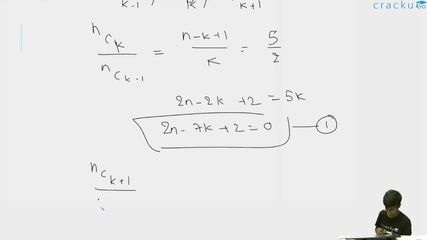
$$\frac{\binom{n}{k}}{\binom{n}{k-1}}=\frac{n-k+1}{k}.$$ Setting $$k=r$$ gives
$$\frac{\binom{n}{r}}{\binom{n}{r-1}}=\frac{n-r+1}{r}.$$
Setting $$k=r-1$$ gives
$$\frac{\binom{n}{r-1}}{\binom{n}{r-2}}=\frac{n-(r-1)+1}{\,r-1\,}=\frac{n-r+2}{r-1}.$$
Now we equate these expressions to the given ratios.
First ratio:
$$\frac{n-r+1}{r}=\frac{2}{5}.$$
Cross-multiplying, we obtain
$$5(n-r+1)=2r,$$ $$5n-5r+5=2r,$$ $$5n+5=7r,$$ $$r=\frac{5n+5}{7}. \quad -(1)$$
Second ratio:
$$\frac{n-r+2}{r-1}=\frac{5}{12}.$$
Cross-multiplying, we obtain
$$12(n-r+2)=5(r-1),$$ $$12n-12r+24=5r-5,$$ $$12n+24=17r-5,$$ $$12n+29=17r,$$ $$r=\frac{12n+29}{17}. \quad -(2)$$
Since both (1) and (2) equal $$r$$, we equate them:
$$\frac{5n+5}{7}=\frac{12n+29}{17}.$$
Cross-multiplying gives
$$17(5n+5)=7(12n+29),$$ $$85n+85=84n+203.$$
Moving like terms to the same side, we get
$$85n-84n=203-85,$$ $$n=118.$$
Because $$n=118$$ is a positive integer and satisfies both equations, it is the required value.
Hence, the correct answer is Option 118.
Was this solution helpful?
Click on the Email ☝️ to Watch the Video Solution
Create a FREE account and get:
_1.webp)

Educational materials for JEE preparation

Ask our AI anything

AI can make mistakes. Please verify important information.
AI can make mistakes. Please verify important information.


