
Join Our JEE Preparation Group
Prep with like-minded aspirants; Get access to free daily tests and study material.
Sign in
Please select an account to continue using cracku.in
↓ →
Join Our JEE Preparation Group
Prep with like-minded aspirants; Get access to free daily tests and study material.
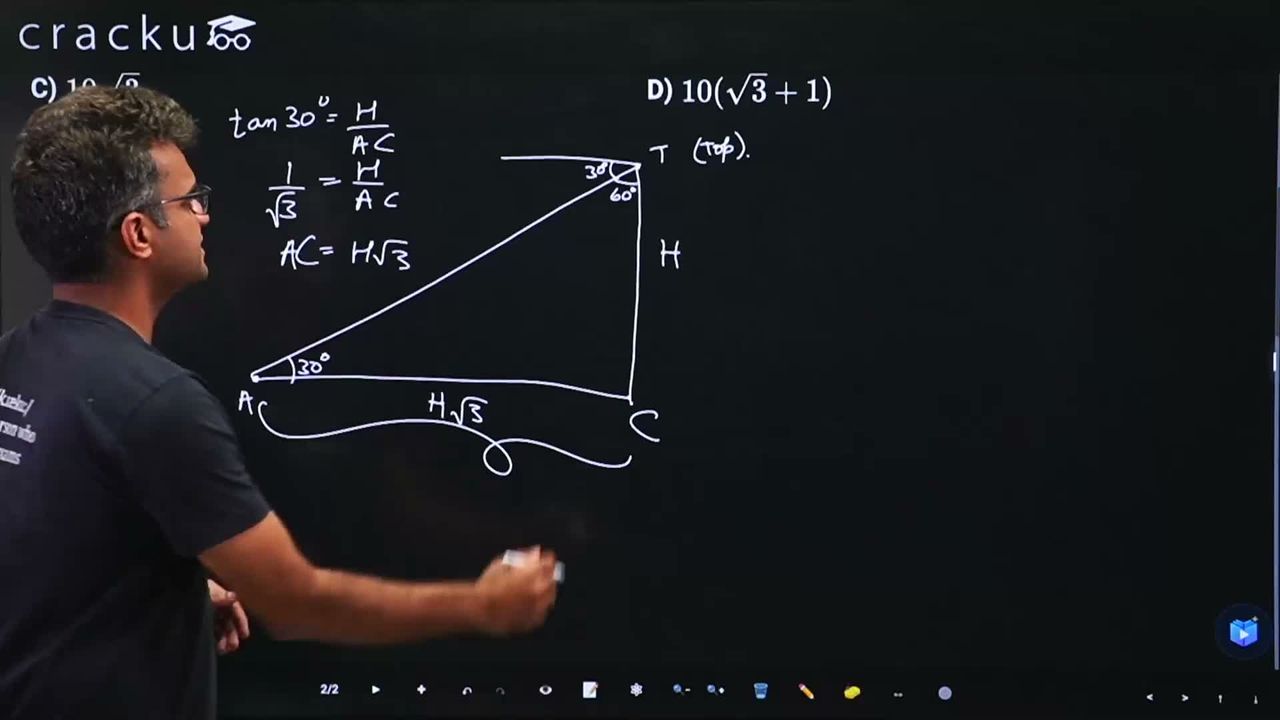
A man is observing, from the top of a tower, a boat speeding towards the tower from a certain point A, with uniform speed. At that point, angle of depression of the boat with the man's eye is 30° (Ignore man's height). After sailing for 20 seconds, towards the base of the tower (which is at the level of water), the boat has reached a point B, where the angle of depression is 45°. Then the time taken (in seconds) by the boat from B to reach the base of the tower is:
Let the height of the tower be $$h$$ and the speed of the boat be $$v$$. Let points A and B be the positions of the boat at the two given instants.
At point A, the angle of depression is 30°, so $$\tan 30° = \frac{h}{d_A}$$, giving $$d_A = h\sqrt{3}$$ where $$d_A$$ is the horizontal distance from the base.
At point B, the angle of depression is 45°, so $$\tan 45° = \frac{h}{d_B}$$, giving $$d_B = h$$.
The distance $$AB = d_A - d_B = h\sqrt{3} - h = h(\sqrt{3} - 1)$$. Since the boat covers this in 20 seconds, the speed is $$v = \frac{h(\sqrt{3} - 1)}{20}$$.
The time taken to travel from B to the base of the tower (distance $$d_B = h$$) is $$t = \frac{h}{v} = \frac{h \times 20}{h(\sqrt{3} - 1)} = \frac{20}{\sqrt{3} - 1}$$.
Rationalizing the denominator: $$t = \frac{20(\sqrt{3} + 1)}{(\sqrt{3} - 1)(\sqrt{3} + 1)} = \frac{20(\sqrt{3} + 1)}{2} = 10(\sqrt{3} + 1)$$.
Therefore, the time taken by the boat from B to reach the base is $$10(\sqrt{3} + 1)$$ seconds.
Was this solution helpful?
Click on the Email ☝️ to Watch the Video Solution
Create a FREE account and get:
_1.webp)

Educational materials for JEE preparation

Ask our AI anything

AI can make mistakes. Please verify important information.
AI can make mistakes. Please verify important information.
