
Join Our JEE Preparation Group
Prep with like-minded aspirants; Get access to free daily tests and study material.
Sign in
Please select an account to continue using cracku.in
↓ →
Join Our JEE Preparation Group
Prep with like-minded aspirants; Get access to free daily tests and study material.
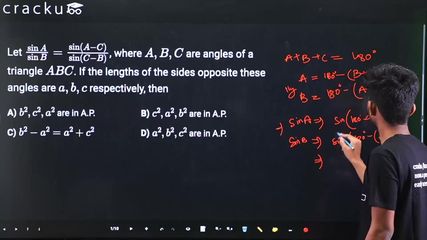
Let $$\frac{\sin A}{\sin B} = \frac{\sin(A-C)}{\sin(C-B)}$$, where $$A, B, C$$ are angles of a triangle $$ABC$$. If the lengths of the sides opposite these angles are $$a, b, c$$ respectively, then
We are given the following relationship between the angles of a triangle $$ABC$$:
$$\frac{\sin A}{\sin B} = \frac{\sin(A-C)}{\sin(C-B)}$$
Also, in any triangle $$ABC$$, we know that:
Substituting these into the left side of the given equation:
$$\frac{\sin(B + C)}{\sin(A + C)} = \frac{\sin(A - C)}{\sin(C - B)}$$
Cross-multiply the terms:
$$\sin(B + C) \cdot \sin(C - B) = \sin(A + C) \cdot \sin(A - C)$$
We can use the standard trigonometric identity: $$\sin(X + Y)\sin(X - Y) = \sin^2 X - \sin^2 Y$$.
Now, set them equal:
$$\sin^2 C - \sin^2 B = \sin^2 A - \sin^2 C$$
Using the Sine Rule ($$\sin \theta \propto \text{side length}$$), we can replace the sine terms with their corresponding side lengths $$a, b,$$ and $$c$$:
$$c^2 - b^2 = a^2 - c^2$$
Rearranging the terms:
$$2c^2 = a^2 + b^2$$
$$c^2 - b^2 = a^2 - c^2$$
There for $$a^2,b^2\ and\ c^2$$ are in A.P.
Was this solution helpful?
Click on the Email ☝️ to Watch the Video Solution
Create a FREE account and get:
_1.webp)

Educational materials for JEE preparation

Ask our AI anything

AI can make mistakes. Please verify important information.
AI can make mistakes. Please verify important information.
