
Join Our JEE Preparation Group
Prep with like-minded aspirants; Get access to free daily tests and study material.
Sign in
Please select an account to continue using cracku.in
↓ →
Join Our JEE Preparation Group
Prep with like-minded aspirants; Get access to free daily tests and study material.
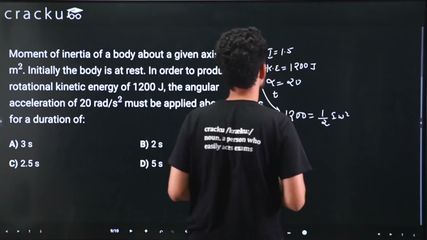
Moment of inertia of a body about a given axis is 1.5 kg m$$^2$$. Initially the body is at rest. In order to produce a rotational kinetic energy of 1200 J, the angular acceleration of 20 rad/s$$^2$$ must be applied about the axis for a duration of:
We have a rigid body whose moment of inertia about the given axis is $$I = 1.5\ \text{kg m}^2$$. The body starts from rest, so its initial angular velocity is $$\omega_0 = 0$$. We wish to give it a rotational kinetic energy of $$K = 1200\ \text{J}$$.
First, we recall the formula for rotational kinetic energy:
$$K = \dfrac{1}{2}\, I \, \omega^2.$$
Here $$\omega$$ is the final angular velocity we must attain. Substituting the known values, we get
$$1200 = \dfrac{1}{2} \times 1.5 \times \omega^2.$$
Multiplying both sides by 2 to clear the fraction:
$$2400 = 1.5 \, \omega^2.$$
Now we isolate $$\omega^2$$ by dividing both sides by 1.5:
$$\omega^2 = \dfrac{2400}{1.5}.$$
Performing the division,
$$\omega^2 = 1600.$$
Taking the square root of both sides gives the required final angular velocity:
$$\omega = \sqrt{1600} = 40\ \text{rad s}^{-1}.$$
Next, we use the relation between angular acceleration and change in angular velocity. Because the body starts from rest and the angular acceleration is constant, the kinematic equation is
$$\omega = \omega_0 + \alpha t.$$
Since $$\omega_0 = 0$$, this reduces to
$$\omega = \alpha t.$$
The given angular acceleration is $$\alpha = 20\ \text{rad s}^{-2}$$. Substituting $$\omega = 40\ \text{rad s}^{-1}$$ and $$\alpha = 20\ \text{rad s}^{-2}$$, we get
$$40 = 20\, t.$$
Solving for $$t$$ by dividing both sides by 20:
$$t = \dfrac{40}{20} = 2\ \text{s}.$$
Hence, the correct answer is Option B.
Was this solution helpful?
Click on the Email ☝️ to Watch the Video Solution
Create a FREE account and get:
_1.webp)

Educational materials for JEE preparation

Ask our AI anything

AI can make mistakes. Please verify important information.
AI can make mistakes. Please verify important information.


