
Join Our JEE Preparation Group
Prep with like-minded aspirants; Get access to free daily tests and study material.
Sign in
Please select an account to continue using cracku.in
↓ →
Join Our JEE Preparation Group
Prep with like-minded aspirants; Get access to free daily tests and study material.
$$\lim_{x \rightarrow \infty}\frac{(2x^{2}-3x+5)(3x-1)^{\frac{x}{2}}}{(3x^{2}+5x+4)\sqrt{(3x+2)^{x}}}$$ is equals to :
$$\frac{2x^{2} - 3x + 5}{3x^{2} + 5x + 4}$$
$$\frac{2 - \frac{3}{x} + \frac{5}{x^{2}}}{3 + \frac{5}{x} + \frac{4}{x^{2}}}$$
As $$x \rightarrow \infty$$, the terms with $$x$$ in the denominator vanish, so this approaches:
$$\frac{2}{3}$$
We simplify the exponential part. Note that $$\sqrt{(3x+2)^{x}} = (3x+2)^{x/2}$$. So the exponential part becomes:
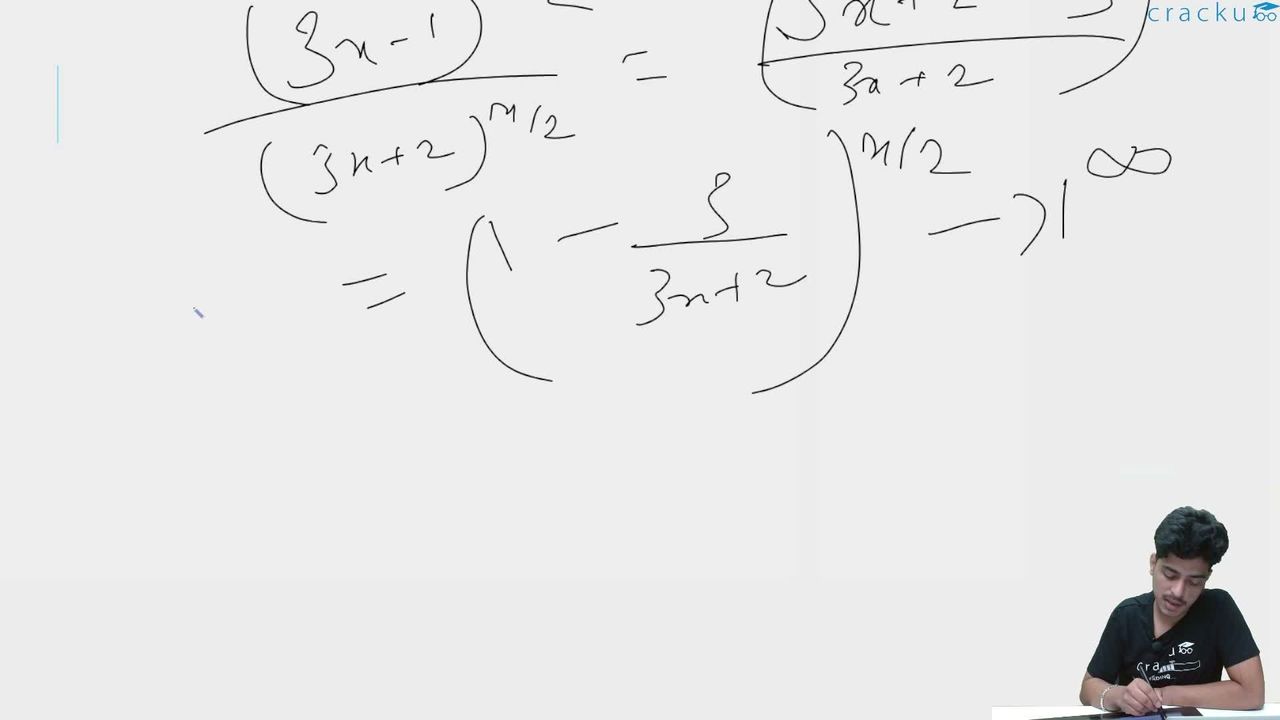
$$\frac{(3x-1)^{x/2}}{(3x+2)^{x/2}} = \left(\frac{3x-1}{3x+2}\right)^{x/2}$$
$$\frac{3x - 1}{3x + 2} = 1 - \frac{3}{3x + 2}$$
$$\lim_{x \rightarrow \infty} \left(1 - \frac{3}{3x + 2}\right)^{x/2}$$
This is of the form $$1^{\infty}$$. We take the natural logarithm of the expression. Let:
$$L = \lim_{x \rightarrow \infty} \frac{x}{2} \cdot \ln\left(1 - \frac{3}{3x + 2}\right)$$
For large $$x$$, using the approximation $$\ln(1 + u) \approx u$$ when $$u \rightarrow 0$$:
$$\ln\left(1 - \frac{3}{3x + 2}\right) \approx -\frac{3}{3x + 2}$$
$$L = \lim_{x \rightarrow \infty} \frac{x}{2} \cdot \left(-\frac{3}{3x + 2}\right)$$
$$L = \lim_{x \rightarrow \infty} \frac{-3x}{2(3x + 2)}$$
$$L = \lim_{x \rightarrow \infty} \frac{-3x}{6x + 4}$$
Dividing numerator and denominator by $$x$$:
$$L = \lim_{x \rightarrow \infty} \frac{-3}{6 + \frac{4}{x}} = \frac{-3}{6} = -\frac{1}{2}$$
So the exponential part equals $$e^{L} = e^{-1/2} = \frac{1}{\sqrt{e}}$$.
$$\lim_{x \rightarrow \infty}\frac{(2x^{2}-3x+5)(3x-1)^{x/2}}{(3x^{2}+5x+4)(3x+2)^{x/2}} = \frac{2}{3} \cdot \frac{1}{\sqrt{e}} = \frac{2}{3\sqrt{e}}$$
Was this solution helpful?
Click on the Email ☝️ to Watch the Video Solution
Create a FREE account and get:
_1.webp)

Educational materials for JEE preparation

Ask our AI anything

AI can make mistakes. Please verify important information.
AI can make mistakes. Please verify important information.
