
Join Our JEE Preparation Group
Prep with like-minded aspirants; Get access to free daily tests and study material.
Sign in
Please select an account to continue using cracku.in
↓ →
Join Our JEE Preparation Group
Prep with like-minded aspirants; Get access to free daily tests and study material.
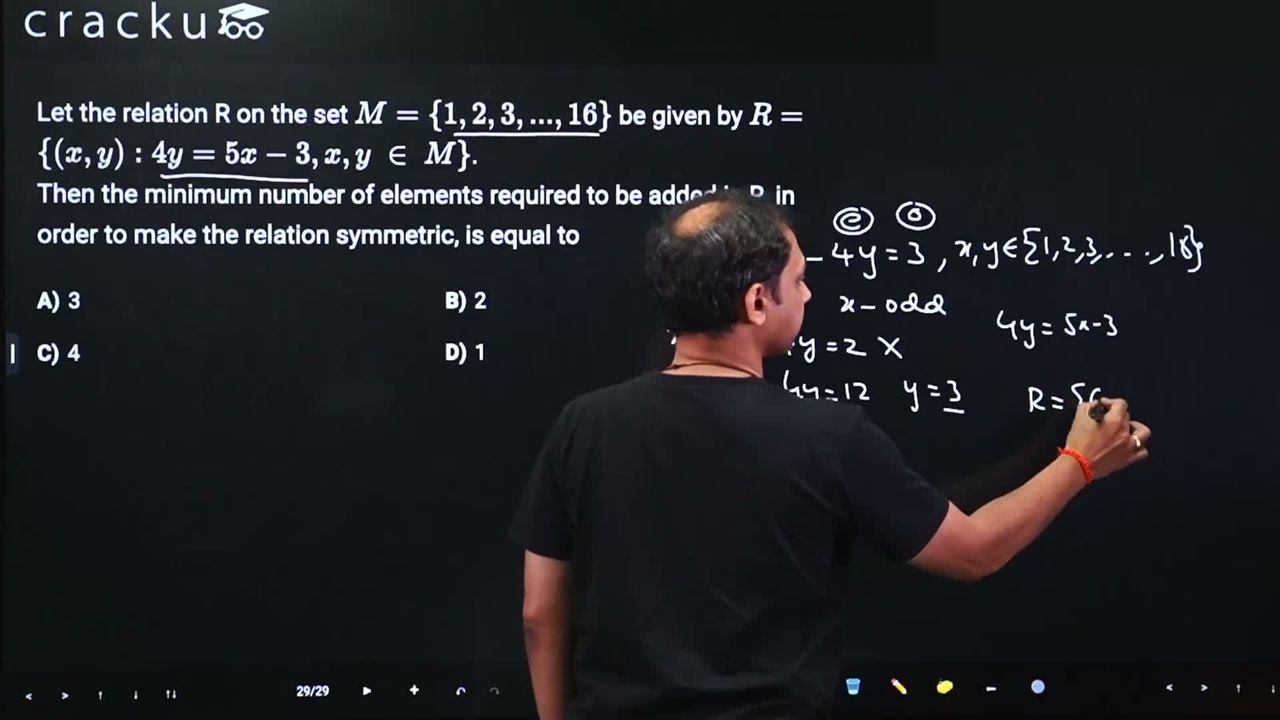
Let the relation R on the set $$ M=\left\{ 1,2,3,...,16 \right\}$$ be given by $$ R=\left\{ (x, y): 4y= 5x-3,x,y \text{ }\isin \text{ }M\right\}$$.
Then the minimum number of elements required to be added in R, in order to make the relation symmetric, is equal to
$$M=\{1,2,3,\dots,16\}$$ and the relation $$R=\{(x,y):4y=5x-3,\;x,y\in M\}$$.
To find all pairs $$(x,y)\in R$$, solve the equation:
$$4y=5x-3\quad\Longrightarrow\quad y=\frac{5x-3}{4}$$ where $$1\le x\le16$$ and $$1\le y\le16$$.
For $$y$$ to be an integer, numerator $$5x-3$$ must be divisible by $$4$$. We use the congruence identity:
If $$5x-3\equiv0\pmod4$$ then $$5x\equiv3\pmod4$$. Since $$5\equiv1\pmod4$$, this gives $$x\equiv3\pmod4\,. $$
Thus the possible values of $$x$$ in $$[1,16]$$ are $$x=3,7,11,15$$. Compute $$y$$ in each case:
Case 1: $$x=3$$
$$y=\frac{5\cdot3-3}{4}=\frac{15-3}{4}=3$$
so $$(3,3)\in R\,. $$
Case 2: $$x=7$$
$$y=\frac{5\cdot7-3}{4}=\frac{35-3}{4}=8$$
so $$(7,8)\in R\,. $$
Case 3: $$x=11$$
$$y=\frac{5\cdot11-3}{4}=\frac{55-3}{4}=13$$
so $$(11,13)\in R\,. $$
Case 4: $$x=15$$
$$y=\frac{5\cdot15-3}{4}=\frac{75-3}{4}=18$$
but $$18>16$$, so this pair is not in $$M$$ and is excluded.
the relation is $$R=\{(3,3),\;(7,8),\;(11,13)\}\,.$$
To make $$R$$ symmetric, for each $$(x,y)\in R$$ we must have $$(y,x)\in R$$.
The pair $$(3,3)$$ is already symmetric. For $$(7,8)$$ we need $$(8,7)$$, and for $$(11,13)$$ we need $$(13,11)$$.
the minimum number of elements to be added is $$2\,. $$
Answer: Option B.
Was this solution helpful?
Click on the Email ☝️ to Watch the Video Solution
Create a FREE account and get:
_1.webp)

Educational materials for JEE preparation

Ask our AI anything

AI can make mistakes. Please verify important information.
AI can make mistakes. Please verify important information.
