
Join Our JEE Preparation Group
Prep with like-minded aspirants; Get access to free daily tests and study material.
Sign in
Please select an account to continue using cracku.in
↓ →
Join Our JEE Preparation Group
Prep with like-minded aspirants; Get access to free daily tests and study material.
Let the parabola $$ y=x^{2}+px-3 $$, meet the coordinate axes at the points P, Q and R . If the circle C with centre at (-1, -1) passes through the points P, Q and R, then the area of $$ \triangle PQR $$ is :
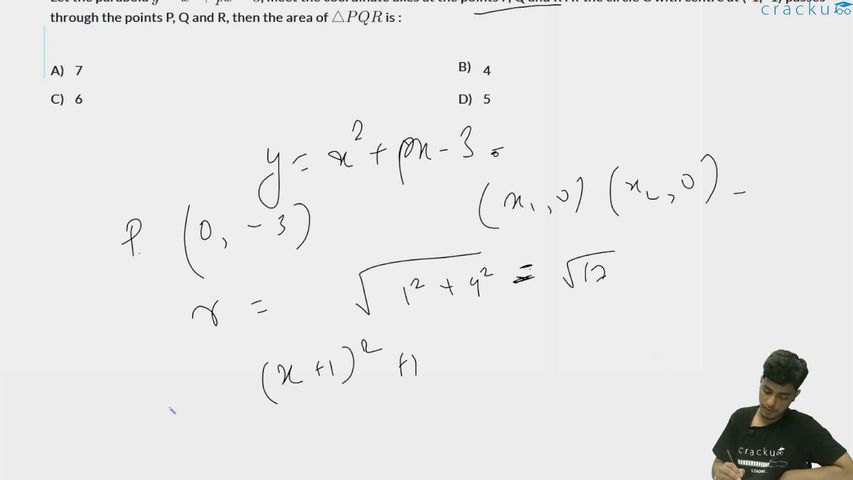
The parabola is given by $$ y = x^2 + p x - 3 $$. It intersects the coordinate axes at points P, Q, and R.
When $$ x = 0 $$, $$ y = (0)^2 + p(0) - 3 = -3 $$. So, R is $$ (0, -3) $$.
When $$ y = 0 $$, $$ x^2 + p x - 3 = 0 $$. Let the roots be $$ x_1 $$ and $$ x_2 $$, so P and Q are $$ (x_1, 0) $$ and $$ (x_2, 0) $$.
The circle has center at $$ (-1, -1) $$ and passes through P, Q, and R. The radius is the distance from the center to any point on the circle.
Distance from center $$ (-1, -1) $$ to R $$ (0, -3) $$:
$$ \sqrt{ (0 - (-1))^2 + (-3 - (-1))^2 } = \sqrt{ (1)^2 + (-2)^2 } = \sqrt{1 + 4} = \sqrt{5} $$
So, the radius $$ r = \sqrt{5} $$.
Since the circle passes through P $$ (x_1, 0) $$ and Q $$ (x_2, 0) $$, the distance from the center to each must also be $$ \sqrt{5} $$.
For P $$ (x_1, 0) $$:
$$ \sqrt{ (x_1 - (-1))^2 + (0 - (-1))^2 } = \sqrt{ (x_1 + 1)^2 + 1^2 } = \sqrt{5} $$
Square both sides:
$$ (x_1 + 1)^2 + 1 = 5 $$
$$ x_1 + 1 = \pm 2 $$
So, $$ x_1 = 1 $$ or $$ x_1 = -3 $$.
Similarly, for Q $$ (x_2, 0) $$:
$$ (x_2 + 1)^2 + 1 = 5 $$
$$ x_2 = 1 $$ or $$ x_2 = -3 $$.
Since the discriminant of $$ x^2 + p x - 3 = 0 $$ is $$ p^2 + 12 > 0 $$ (always positive), there are two distinct real roots. Therefore, the roots are 1 and -3. Assign P as $$ (1, 0) $$ and Q as $$ (-3, 0) $$.
Now, verify the value of p using the sum of roots:
Sum of roots: $$ x_1 + x_2 = 1 + (-3) = -2 = -p $$, so $$ p = 2 $$.
The parabola is $$ y = x^2 + 2x - 3 $$, and the points are P$$ (1, 0) $$, Q$$ (-3, 0) $$, and R$$ (0, -3) $$.
area given points $$ (x_1, y_1) $$, $$ (x_2, y_2) $$, $$ (x_3, y_3) $$:
Area $$= \frac{1}{2} \left| x_1(y_2 - y_3) + x_2(y_3 - y_1) + x_3(y_1 - y_2) \right|$$
Substitute $$ x_1 = 1 $$, $$ y_1 = 0 $$, $$ x_2 = -3 $$, $$ y_2 = 0 $$, $$ x_3 = 0 $$, $$ y_3 = -3 $$:
Area $$= \frac{1}{2} \left| 1 \cdot (0 - (-3)) + (-3) \cdot (-3 - 0) + 0 \cdot (0 - 0) \right|$$
$$= \frac{1}{2} \left| 1 \cdot 3 + (-3) \cdot (-3) + 0 \right|$$
$$= \frac{1}{2} \times 12 = 6$$
Therefore, the area of $$ \triangle PQR $$ is 6.
Was this solution helpful?
Click on the Email ☝️ to Watch the Video Solution
Create a FREE account and get:
_1.webp)

Educational materials for JEE preparation

Ask our AI anything

AI can make mistakes. Please verify important information.
AI can make mistakes. Please verify important information.
