
Join Our JEE Preparation Group
Prep with like-minded aspirants; Get access to free daily tests and study material.
Sign in
Please select an account to continue using cracku.in
↓ →
Join Our JEE Preparation Group
Prep with like-minded aspirants; Get access to free daily tests and study material.
Given below are two statements. One is labelled as Assertion A and the other is labelled as Reason R.
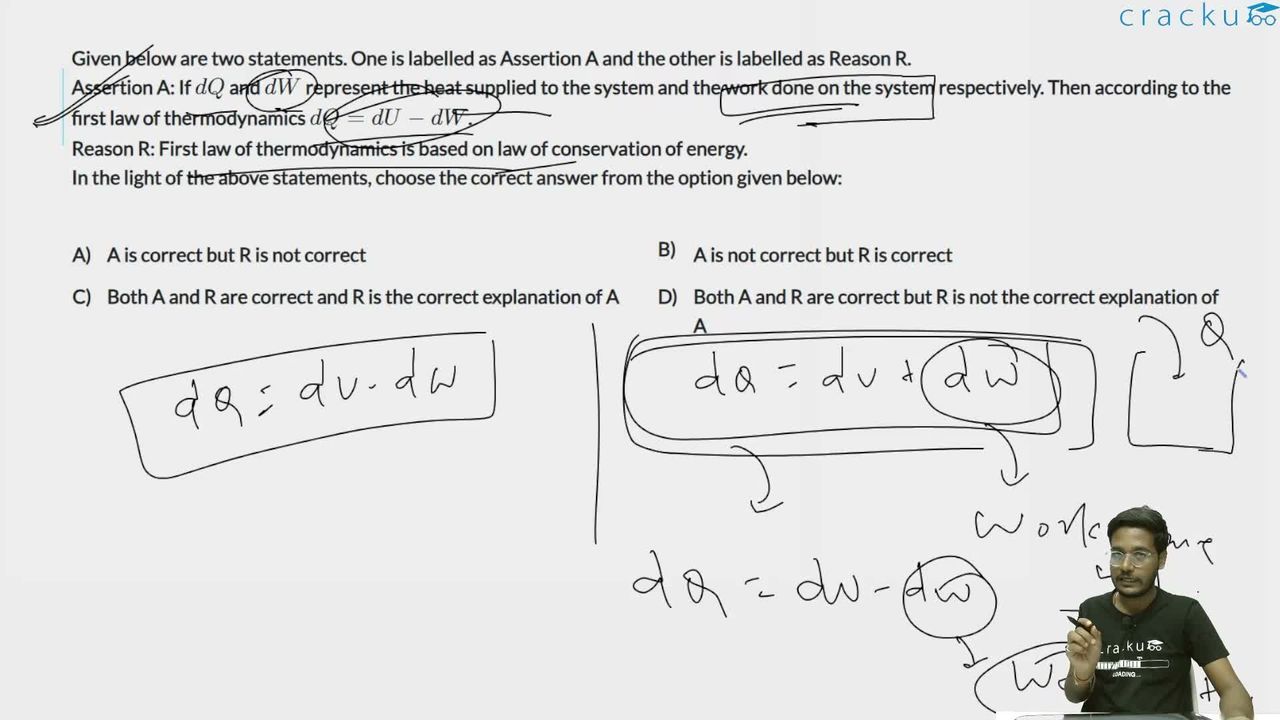
Assertion A: If $$dQ$$ and $$dW$$ represent the heat supplied to the system and the work done on the system respectively. Then according to the first law of thermodynamics $$dQ = dU - dW$$.
Reason R: First law of thermodynamics is based on law of conservation of energy.
In the light of the above statements, choose the correct answer from the option given below:
If $$dQ$$ and $$dW$$ represent the heat supplied to the system and the work done on the system respectively, then according to the first law of thermodynamics $$dQ = dU - dW$$. The first law states that the change in internal energy equals heat added plus work done on the system: $$dU = dQ + dW_{\text{on}}$$ where $$dW_{\text{on}}$$ is the work done on the system (IUPAC convention). Rearranging gives $$dQ = dU - dW_{\text{on}}$$, matching the assertion since $$dW$$ denotes the work done on the system. Assertion A is correct.
The first law of thermodynamics is indeed a statement of the law of conservation of energy applied to thermodynamic systems — energy can neither be created nor destroyed, only converted from one form to another. Reason R is correct.
The mathematical form $$dQ = dU - dW$$ follows directly from energy conservation: the heat supplied equals the change in internal energy minus the work done on the system, so R provides the fundamental basis for A. R is the correct explanation of A.
Both A and R are correct, and R is the correct explanation of A.
Was this solution helpful?
Click on the Email ☝️ to Watch the Video Solution
Create a FREE account and get:
_1.webp)

Educational materials for JEE preparation

Ask our AI anything

AI can make mistakes. Please verify important information.
AI can make mistakes. Please verify important information.
