
Join Our JEE Preparation Group
Prep with like-minded aspirants; Get access to free daily tests and study material.
Sign in
Please select an account to continue using cracku.in
↓ →
Join Our JEE Preparation Group
Prep with like-minded aspirants; Get access to free daily tests and study material.
Given below are two statements: one is labelled as Assertion A and the other is labelled as Reason R.
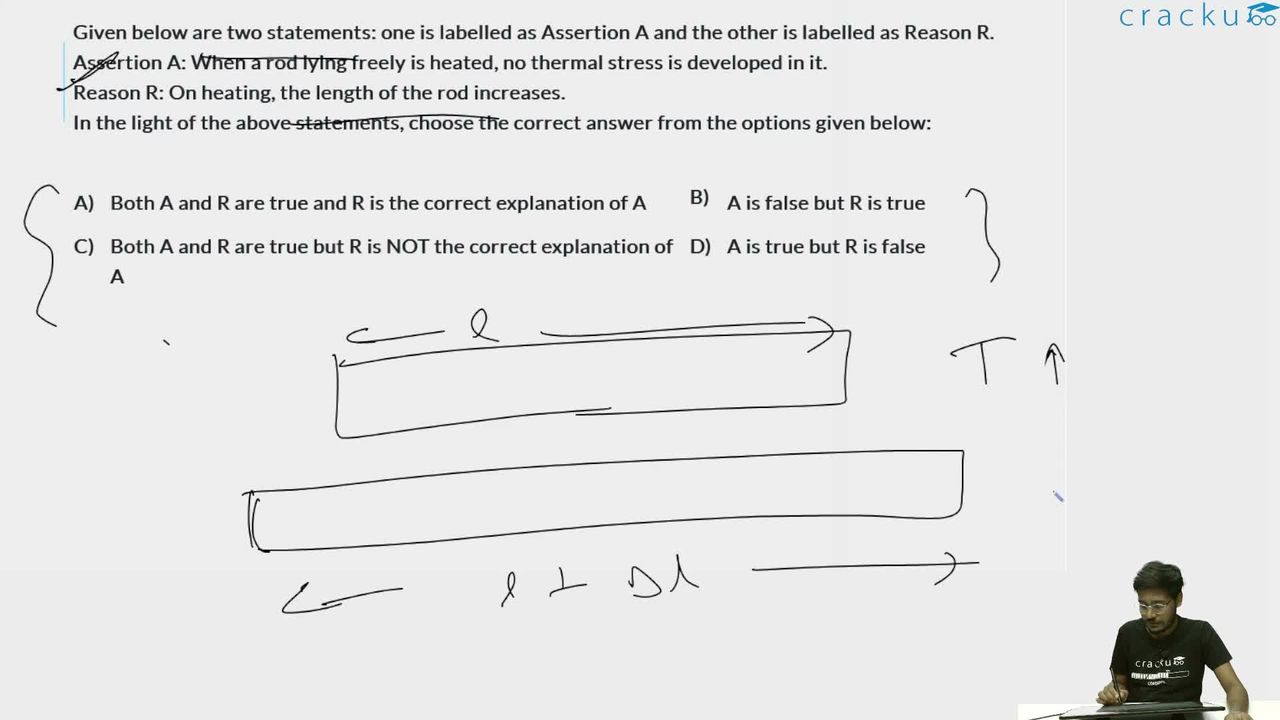
Assertion A: When a rod lying freely is heated, no thermal stress is developed in it.
Reason R: On heating, the length of the rod increases.
In the light of the above statements, choose the correct answer from the options given below:
Thermal stress in a material arises when the material is constrained and prevented from expanding or contracting due to temperature changes. The stress is given by $$\sigma = Y \alpha \Delta T$$, where $$Y$$ is Young's modulus, $$\alpha$$ is the coefficient of linear expansion, and $$\Delta T$$ is the temperature change.
When a rod is lying freely and is heated, it is free to expand without any constraint. Since there is no external force or support preventing the expansion, no thermal stress develops in the rod. Therefore, Assertion A is true.
Reason R states that on heating, the length of the rod increases. This is indeed true for most materials, as they undergo thermal expansion when heated.
However, R is not the correct explanation of A. The fact that the rod's length increases on heating is not why thermal stress is absent. Thermal stress is absent because the rod is free to expand. If the rod were fixed at both ends, it would still try to expand on heating, but the constraint would cause thermal stress. The key factor is the freedom to expand, not the expansion itself.
Therefore, both A and R are true but R is NOT the correct explanation of A, which corresponds to Option (3).
Was this solution helpful?
Click on the Email ☝️ to Watch the Video Solution
Create a FREE account and get:
_1.webp)

Educational materials for JEE preparation

Ask our AI anything

AI can make mistakes. Please verify important information.
AI can make mistakes. Please verify important information.
