
Join Our JEE Preparation Group
Prep with like-minded aspirants; Get access to free daily tests and study material.
Sign in
Please select an account to continue using cracku.in
↓ →
Join Our JEE Preparation Group
Prep with like-minded aspirants; Get access to free daily tests and study material.
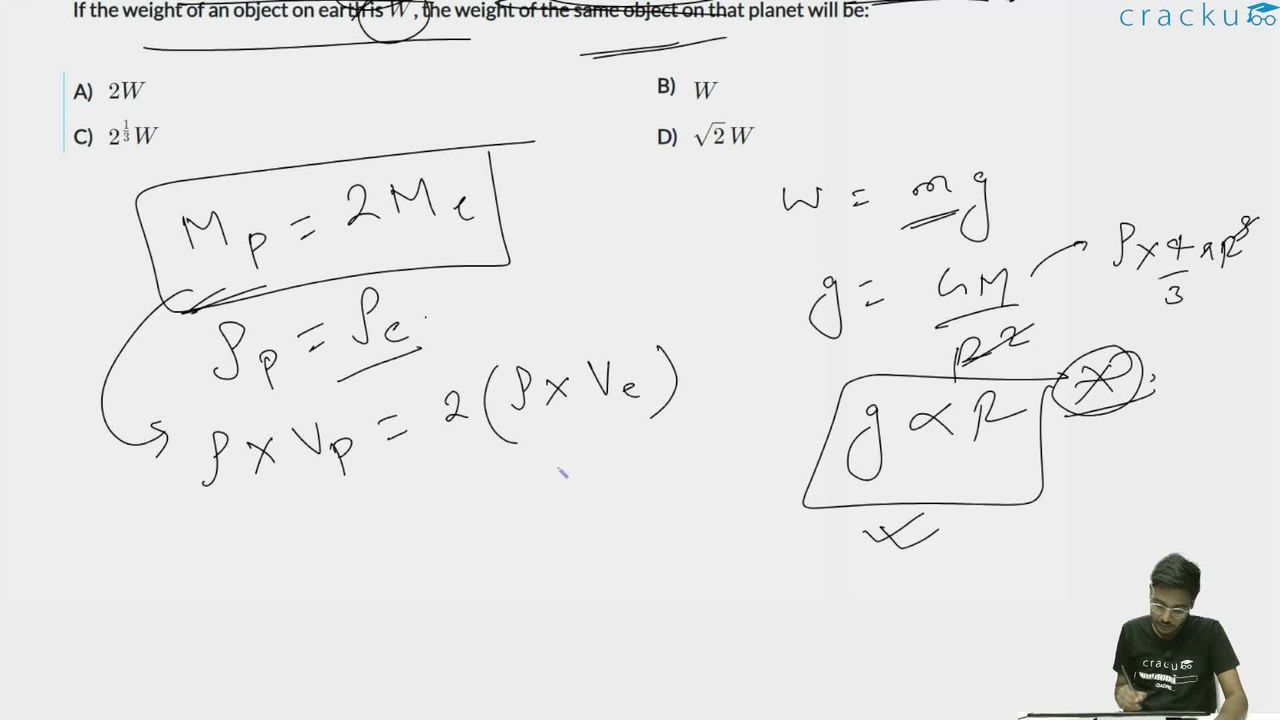
Consider a planet in some solar system that has a mass double the mass of earth and density equal to the average density of the earth. If the weight of an object on earth is $$W$$, the weight of the same object on that planet will be:
First, recall that the weight of an object on any planet is given by the familiar relation $$W = m\,g,$$ where $$m$$ is the mass of the object and $$g$$ is the acceleration due to gravity on that planet. For two different planets we can compare the weights by comparing their respective values of $$g.$$
The acceleration due to gravity at the surface of a spherical planet is obtained from Newton’s law of gravitation:
$$g = \dfrac{G\,M}{R^{2}},$$
where $$G$$ is the universal gravitational constant, $$M$$ is the mass of the planet, and $$R$$ is its radius. Thus, if we know how the mass and radius of another planet relate to the Earth’s, we can get the ratio of the two $$g$$’s.
We are told that the new planet has a mass which is double the mass of the Earth. Writing Earth’s mass as $$M_E,$$ we have
$$M_P = 2\,M_E.$$
Next, we are told that the density of the new planet is equal to the average density of the Earth. Density is defined as mass divided by volume. For a sphere, volume is $$\dfrac{4}{3}\pi R^{3},$$ so
$$\rho = \dfrac{M}{\frac{4}{3}\pi R^{3}} \quad\Longrightarrow\quad M = \rho\,\frac{4}{3}\pi R^{3}.$$
If the densities of the two planets are equal, we can set up the equality
$$\rho_P = \rho_E \quad\Longrightarrow\quad \dfrac{M_P}{\frac{4}{3}\pi R_P^{3}} = \dfrac{M_E}{\frac{4}{3}\pi R_E^{3}}.$$
Cancelling the common factors $$\frac{4}{3}\pi$$ on both sides gives
$$\dfrac{M_P}{R_P^{3}} = \dfrac{M_E}{R_E^{3}}.$$
Substituting $$M_P = 2\,M_E$$ into the above relation, we get
$$\dfrac{2\,M_E}{R_P^{3}} = \dfrac{M_E}{R_E^{3}}.$$
Dividing both sides by $$M_E$$ and then cross-multiplying, we have
$$2\,R_E^{3} = R_P^{3}.$$
Taking the cube root of both sides, we obtain the radius of the planet in terms of Earth’s radius:
$$R_P = 2^{\frac{1}{3}}\,R_E.$$
Now we can find the ratio of the gravitational accelerations. Using the formula $$g = \dfrac{G\,M}{R^{2}},$$ we write
$$\dfrac{g_P}{g_E} = \dfrac{\dfrac{G\,M_P}{R_P^{2}}}{\dfrac{G\,M_E}{R_E^{2}}}.$$
The constant $$G$$ cancels out, so
$$\dfrac{g_P}{g_E} = \dfrac{M_P}{M_E}\,\dfrac{R_E^{2}}{R_P^{2}}.$$
Substituting $$M_P = 2\,M_E$$ and $$R_P = 2^{\frac{1}{3}}\,R_E,$$ we get
$$\dfrac{g_P}{g_E} = 2 \times \dfrac{R_E^{2}}{\left(2^{\frac{1}{3}}\,R_E\right)^{2}}.$$
Simplifying the expression inside the denominator first,
$$(2^{\tfrac{1}{3}}\,R_E)^{2} = 2^{\tfrac{2}{3}}\,R_E^{2}.$$
Therefore,
$$\dfrac{g_P}{g_E} = 2 \times \dfrac{R_E^{2}}{2^{\tfrac{2}{3}}\,R_E^{2}}.$$
The factor $$R_E^{2}$$ cancels, giving
$$\dfrac{g_P}{g_E} = \dfrac{2}{2^{\tfrac{2}{3}}} = 2^{1 - \tfrac{2}{3}} = 2^{\tfrac{1}{3}}.$$
Finally, the weight of the object on the new planet will be
$$W_P = m\,g_P = m\,g_E \left(\dfrac{g_P}{g_E}\right) = W \times 2^{\tfrac{1}{3}}.$$
So the weight becomes $$2^{\tfrac{1}{3}}\,W.$$
Hence, the correct answer is Option C.
Was this solution helpful?
Click on the Email ☝️ to Watch the Video Solution
Create a FREE account and get:
_1.webp)

Educational materials for JEE preparation

Ask our AI anything

AI can make mistakes. Please verify important information.
AI can make mistakes. Please verify important information.
