
Join Our JEE Preparation Group
Prep with like-minded aspirants; Get access to free daily tests and study material.
Sign in
Please select an account to continue using cracku.in
↓ →
Join Our JEE Preparation Group
Prep with like-minded aspirants; Get access to free daily tests and study material.
A vertical pole fixed to the horizontal ground is divided in the ratio 3 : 7 by a mark on it with lower part shorter than the upper part. If the two parts subtend equal angles at a point on the ground 18 m away from the base of the pole, then the height of the pole (in meters) is:
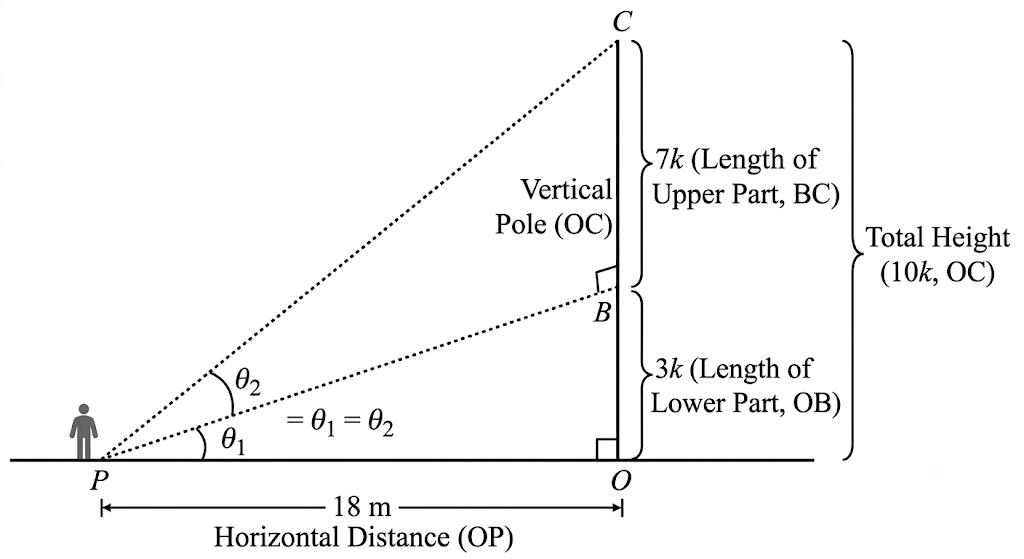
Let us denote the foot of the pole on the ground by the point $$O$$. The pole itself is vertical, so its topmost point is directly above $$O$$.
The mark that divides the pole is such that the lower part and the upper part are in the ratio $$3:7$$, with the lower part shorter. If we let the common proportionality constant be $$k$$ metres, then
$$\text{length of lower part } = 3k,$$ $$\text{length of upper part } = 7k,$$ $$\text{total height of pole } = 3k + 7k = 10k.$$
Now choose a point $$P$$ on the horizontal ground such that the horizontal distance between $$P$$ and the foot $$O$$ of the pole is $$18\text{ m}$$. According to the question, the two parts of the pole individually subtend equal visual angles at the point $$P$$.
It is convenient to introduce the heights of the relevant points above the ground:
$$O : \text{height } 0,$$ $$B : \text{height } 3k,$$ $$C : \text{height } 10k.$$
The two visual angles at $$P$$ are:
$$\theta_1 = \angle OPB = \arctan\!\left(\frac{3k}{18}\right) - \arctan\!\left(\frac{0}{18}\right)$$ $$\phantom{\theta_1}= \arctan\!\left(\frac{3k}{18}\right),$$
$$\theta_2 = \angle BPC = \arctan\!\left(\frac{10k}{18}\right) - \arctan\!\left(\frac{3k}{18}\right).$$
The condition given is $$\theta_1 = \theta_2$$, so
$$\arctan\!\left(\frac{3k}{18}\right) \;=\; \arctan\!\left(\frac{10k}{18}\right) - \arctan\!\left(\frac{3k}{18}\right).$$
Set $$\alpha = \arctan\!\left(\frac{3k}{18}\right).$$ Then the equality becomes
$$\alpha = \arctan\!\left(\frac{10k}{18}\right) - \alpha,$$
so that
$$2\alpha = \arctan\!\left(\frac{10k}{18}\right).$$
Next we use the double-angle formula for tangent, namely $$\tan(2\alpha) = \frac{2\tan\alpha}{1 - \tan^{2}\alpha}.$$
We have $$\tan\alpha = \frac{3k}{18} = \frac{k}{6},$$ hence
$$\tan(2\alpha) = \frac{2\left(\tfrac{k}{6}\right)}{1 - \left(\tfrac{k}{6}\right)^{2}} = \frac{\tfrac{2k}{6}}{1 - \tfrac{k^{2}}{36}} = \frac{\tfrac{k}{3}}{1 - \tfrac{k^{2}}{36}}.$$
But $$\tan(2\alpha)$$ is also, from above, $$\tan\!\Bigl(\arctan\!\bigl(\tfrac{10k}{18}\bigr)\Bigr) = \frac{10k}{18} = \frac{5k}{9}.$$
Equating the two expressions for $$\tan(2\alpha)$$ gives
$$\frac{\tfrac{k}{3}}{1 - \tfrac{k^{2}}{36}} = \frac{5k}{9}.$$
The factor $$k\neq 0$$ cancels out, leaving
$$\frac{1}{3\!\!}\;\Big/\!\!\left(1 - \frac{k^{2}}{36}\right) = \frac{5}{9}.$$
Cross-multiplying,
$$\frac{1}{3} = \frac{5}{9}\left(1 - \frac{k^{2}}{36}\right).$$
Multiply both sides by $$9$$:
$$3 = 5\left(1 - \frac{k^{2}}{36}\right).$$
Expand the right-hand side:
$$3 = 5 - \frac{5k^{2}}{36}.$$
Transpose $$5$$ to the left:
$$3 - 5 = -\frac{5k^{2}}{36},$$ $$-2 = -\frac{5k^{2}}{36}.$$
Multiply both sides by $$-1$$:
$$2 = \frac{5k^{2}}{36}.$$
Multiply by $$36$$:
$$72 = 5k^{2}.$$
Hence
$$k^{2} = \frac{72}{5}, \quad k = \sqrt{\frac{72}{5}} = \frac{6\sqrt{2}}{\sqrt{5}} = \frac{6\sqrt{10}}{5}.$$
The total height of the pole is
$$10k = 10 \times \frac{6\sqrt{10}}{5} = \frac{60\sqrt{10}}{5} = 12\sqrt{10}\text{ metres}.$$
Hence, the correct answer is Option C.
Was this solution helpful?
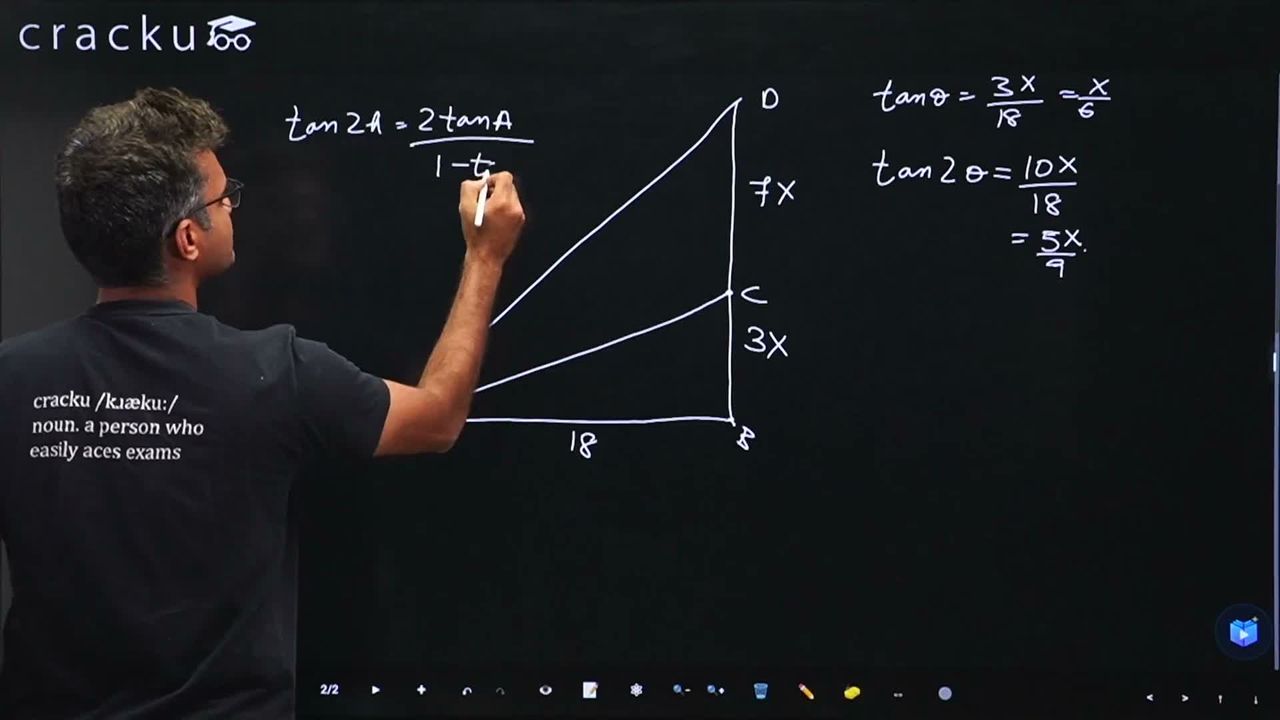
Click on the Email ☝️ to Watch the Video Solution
Create a FREE account and get:
_1.webp)

Educational materials for JEE preparation

Ask our AI anything

AI can make mistakes. Please verify important information.
AI can make mistakes. Please verify important information.
