
Join Our JEE Preparation Group
Prep with like-minded aspirants; Get access to free daily tests and study material.
Sign in
Please select an account to continue using cracku.in
↓ →
Join Our JEE Preparation Group
Prep with like-minded aspirants; Get access to free daily tests and study material.
A plane passing through the point $$(3, 1, 1)$$ contains two lines whose direction ratios are 1, -2, 2 and 2, 3, -1 respectively. If this plane also passes through the point $$(\alpha, -3, 5)$$, then $$\alpha$$ is equal to:
We are given that the required plane passes through the fixed point $$P(3,\,1,\,1)$$ and also contains two distinct lines whose direction-ratio (d.r.) triplets are $$\langle 1,\,-2,\,2\rangle$$ and $$\langle 2,\,3,\,-1\rangle$$ respectively. A direction vector of a line lying in the plane is automatically a vector lying in the plane; hence both vectors
$$\vec{a}=1\,\hat i-2\,\hat j+2\,\hat k\quad\text{and}\quad\vec{b}=2\,\hat i+3\,\hat j-1\,\hat k$$
are coplanar with the required plane. For a plane, any vector normal (perpendicular) to it is obtained by taking the vector (cross) product of two non-parallel vectors lying in the plane.
Formula stated: For vectors $$\vec{a}=(a_1,a_2,a_3)$$ and $$\vec{b}=(b_1,b_2,b_3)$$, the cross product $$\vec{a}\times\vec{b}$$ is
$$\vec{a}\times\vec{b}=\Bigl(a_2b_3-a_3b_2,\;a_3b_1-a_1b_3,\;a_1b_2-a_2b_1\Bigr).$$
Now we compute $$\vec{n}=\vec{a}\times\vec{b}$$ to get a normal vector of the plane.
Writing the determinant step:
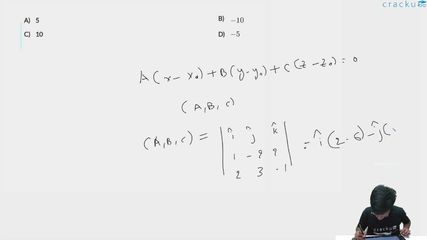
$$ \vec{n}= \begin{vmatrix} \hat i & \hat j & \hat k\\ 1 & -2 & 2\\ 2 & 3 & -1 \end{vmatrix} =\hat i\bigl((-2)(-1)-2\cdot 3\bigr) -\hat j\bigl(1\cdot(-1)-2\cdot2\bigr) +\hat k\bigl(1\cdot3-(-2)\cdot2\bigr). $$
Simplifying each component step by step:
First component (with $$\hat i$$): $$(-2)(-1)=2,\; 2\cdot3=6,\; 2-6=-4.$$ Second component (with $$\hat j$$): $$1\cdot(-1)=-1,\; 2\cdot2=4,\; -1-4=-5,$$ but a minus sign is in front, so it becomes $$-(-5)=+5.$$ Third component (with $$\hat k$$): $$1\cdot3=3,\; (-2)(2)=-4,\; 3-(-4)=3+4=7.$$
Thus
$$\vec{n}=(-4)\,\hat i+5\,\hat j+7\,\hat k,$$ so a normal vector to the plane is $$(-4,\,5,\,7).$$
Once a normal $$\vec{n}=(A,B,C)$$ and a known point $$P(x_0,y_0,z_0)$$ are available, the point-normal form of the plane is stated as
$$A(x-x_0)+B(y-y_0)+C(z-z_0)=0.$$ Here $$A=-4,\;B=5,\;C=7$$ and $$(x_0,y_0,z_0)=(3,\,1,\,1).$$ Substituting them, we get
$$-4\bigl(x-3\bigr)+5\bigl(y-1\bigr)+7\bigl(z-1\bigr)=0.$$
Now we use the extra information that the same plane also passes through the point $$Q(\alpha,\,-3,\,5).$$ Substituting $$x=\alpha,\;y=-3,\;z=5$$ in the plane’s equation gives
$$-4\bigl(\alpha-3\bigr)+5\bigl(-3-1\bigr)+7\bigl(5-1\bigr)=0.$$
We evaluate each bracket carefully: For the first term: $$\alpha-3$$ remains as it is. For the second term: $$-3-1=-4.$$ For the third term: $$5-1=4.$$ So the equation becomes
$$-4(\alpha-3)+5(-4)+7(4)=0.$$
Next we expand and simplify term by term: First term: $$-4(\alpha-3)=-4\alpha+12.$$ Second term: $$5(-4)=-20.$$ Third term: $$7(4)=28.$$
Adding all three numbers we get
$$(-4\alpha+12)+(-20)+28=0.$$
Combine the constants: $$12-20=-8,$$ and $$-8+28=20.$$ Hence
$$-4\alpha+20=0.$$
Solving for $$\alpha$$, we move $$20$$ to the other side:
$$-4\alpha=-20.$$
Now divide by $$-4$$:
$$\alpha=\dfrac{-20}{-4}=5.$$
Hence, the correct answer is Option A.
Was this solution helpful?
Click on the Email ☝️ to Watch the Video Solution
Create a FREE account and get:
_1.webp)

Educational materials for JEE preparation

Ask our AI anything

AI can make mistakes. Please verify important information.
AI can make mistakes. Please verify important information.


