
Join Our JEE Preparation Group
Prep with like-minded aspirants; Get access to free daily tests and study material.
Sign in
Please select an account to continue using cracku.in
↓ →
Join Our JEE Preparation Group
Prep with like-minded aspirants; Get access to free daily tests and study material.
Let the mean of 50 observations is 15 and the standard deviation is 2. However, one observation was wrongly recorded. The sum of the correct and incorrect observations is 70. If the mean of the correct set of observations is 16, then the variance of the correct set is equal to
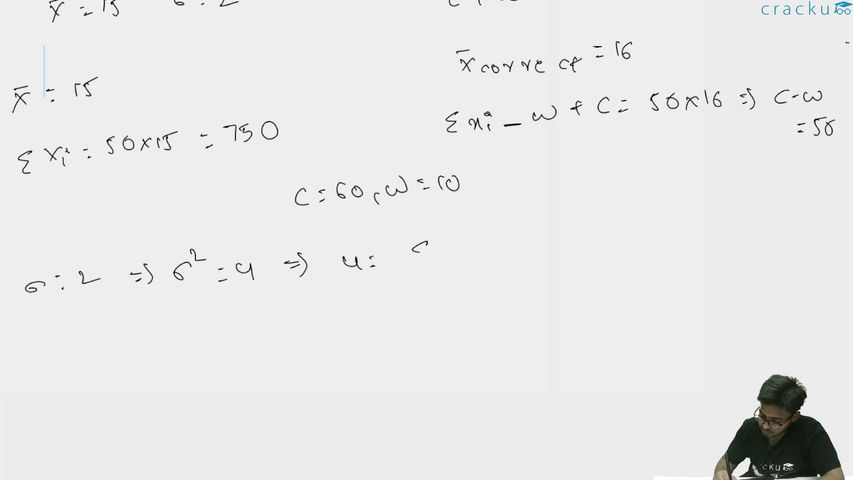
We are given 50 observations with mean 15 and standard deviation 2. One observation was wrongly recorded, and the sum of the correct and incorrect observations is 70. The corrected mean is 16. We need to find the corrected variance.
First, let the wrong observation be $$w$$ and the correct observation be $$c$$. Since $$w + c = 70$$, we can express both values in terms of their sum. Next, the original sum of observations is $$\sum x_i = 50 \times 15 = 750$$, and the corrected sum becomes $$750 - w + c = 50 \times 16 = 800$$, which implies $$c - w = 50$$. Solving these equations gives $$c = 60$$ and $$w = 10$$.
Now we find the original sum of squares. Using the relation $$\sigma^2 = \frac{\sum x_i^2}{n} - \bar{x}^2$$ and substituting $$4 = \frac{\sum x_i^2}{50} - 225$$ yields $$\sum x_i^2 = 50 \times 229 = 11450$$.
Substituting the wrong and correct values into the sum of squares gives the corrected sum of squares as $$\sum x_i^2 \text{(corrected)} = 11450 - w^2 + c^2 = 11450 - 100 + 3600 = 14950$$.
Finally, the corrected variance is calculated as $$\text{Variance} = \frac{\sum x_i^2 \text{(corrected)}}{50} - \bar{x}_{new}^2 = \frac{14950}{50} - 16^2 = 299 - 256 = 43$$. Therefore, the answer is Option C: $$43$$.
Was this solution helpful?
Click on the Email ☝️ to Watch the Video Solution
Create a FREE account and get:
_1.webp)

Educational materials for JEE preparation

Ask our AI anything

AI can make mistakes. Please verify important information.
AI can make mistakes. Please verify important information.
