
Join Our JEE Preparation Group
Prep with like-minded aspirants; Get access to free daily tests and study material.
Sign in
Please select an account to continue using cracku.in
↓ →
Join Our JEE Preparation Group
Prep with like-minded aspirants; Get access to free daily tests and study material.
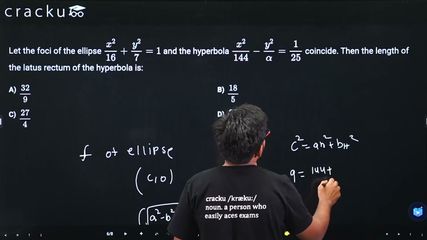
Let the foci of the ellipse $$\dfrac{x^2}{16} + \dfrac{y^2}{7} = 1$$ and the hyperbola $$\dfrac{x^2}{144} - \dfrac{y^2}{\alpha} = \dfrac{1}{25}$$ coincide. Then the length of the latus rectum of the hyperbola is:
We need to find the length of the latus rectum of the hyperbola whose foci coincide with those of the ellipse given by $$\dfrac{x^2}{16} + \dfrac{y^2}{7} = 1$$. For this ellipse, $$a^2 = 16$$ and $$b^2 = 7$$, so $$c^2 = a^2 - b^2 = 16 - 7 = 9$$ and hence $$c = 3$$. Therefore, the foci of the ellipse lie at $$(\pm 3,0)\,$$.
Turning to the hyperbola, its equation is $$\dfrac{x^2}{144} - \dfrac{y^2}{\alpha} = \dfrac{1}{25}\,. $$ Dividing both sides by $$\tfrac{1}{25}$$ converts this into the standard form $$\dfrac{x^2}{144/25} - \dfrac{y^2}{\alpha/25} = 1\,, $$ which shows that $$a_h^2 = \dfrac{144}{25}$$ and $$b_h^2 = \dfrac{\alpha}{25}\,$$, so that $$a_h = \dfrac{12}{5}\,.$$
Since the foci of the hyperbola must coincide with those of the ellipse, we set $$c_h = 3$$. For a hyperbola, $$c_h^2 = a_h^2 + b_h^2\,, $$ thus $$c_h^2 = \dfrac{144 + \alpha}{25}$$ and with $$c_h^2 = 9$$ we obtain $$9 = \dfrac{144 + \alpha}{25}\,, $$ which gives $$144 + \alpha = 225$$ and hence $$\alpha = 81\,. $$ It follows that $$b_h^2 = \dfrac{81}{25}\,.$$
The length of the latus rectum of a hyperbola is given by $$\dfrac{2\,b_h^2}{a_h}\,. $$ Substituting the values found above yields
$$\frac{2\,b_h^2}{a_h} = \frac{2 \times \frac{81}{25}}{\frac{12}{5}} = \frac{\frac{162}{25}}{\frac{12}{5}} = \frac{162}{25} \times \frac{5}{12} = \frac{162}{60} = \frac{27}{10}\,.$$
The correct answer is Option D: $$\dfrac{27}{10}\,.$$
Was this solution helpful?
Click on the Email ☝️ to Watch the Video Solution
Create a FREE account and get:
_1.webp)

Educational materials for JEE preparation

Ask our AI anything

AI can make mistakes. Please verify important information.
AI can make mistakes. Please verify important information.
