
Join Our JEE Preparation Group
Prep with like-minded aspirants; Get access to free daily tests and study material.
Sign in
Please select an account to continue using cracku.in
↓ →
Join Our JEE Preparation Group
Prep with like-minded aspirants; Get access to free daily tests and study material.
If the two lines $$x + (a-1)y = 1$$ and $$2x + a^2y = 1$$, $$(a \in R - \{0, 1\})$$ are perpendicular, then the distance of their point of intersection from the origin is:
We are given the two straight-line equations $$x + (a-1)y = 1$$ and $$2x + a^{2}y = 1$$, where the real number $$a$$ is restricted by $$a \neq 0,\,1$$. Because the lines are stated to be perpendicular, we first express each line in slope-intercept form so that we can compare their slopes.
Starting with the first line, we isolate $$y$$:
$$x + (a-1)y = 1$$
$$\Rightarrow (a-1)y = 1 - x$$
$$\Rightarrow y = \dfrac{1 - x}{\,a-1\,}$$
Hence the slope of the first line is
$$m_{1} = \dfrac{-1}{\,a-1\,}.$$
Now we treat the second line in the same way:
$$2x + a^{2}y = 1$$
$$\Rightarrow a^{2}y = 1 - 2x$$
$$\Rightarrow y = \dfrac{1 - 2x}{\,a^{2}}$$
So the slope of the second line is
$$m_{2} = \dfrac{-2}{\,a^{2}}.$$
For two lines to be perpendicular, the product of their slopes must be $$-1$$. Therefore we impose
$$m_{1}\,m_{2} = -1.$$
Substituting the expressions found above, we get
$$\left(\dfrac{-1}{\,a-1\,}\right)\!\left(\dfrac{-2}{\,a^{2}}\right) = -1.$$
Because the two minus signs give a plus sign, the left-hand side becomes
$$\dfrac{2}{(a-1)a^{2}} = -1.$$
Now we cross-multiply to clear the denominator:
$$2 = -(a-1)a^{2}.$$
Removing the minus sign by multiplying both sides by $$-1$$ yields
$$(a-1)a^{2} = -2.$$
Expanding the left-hand side gives
$$a^{3} - a^{2} + 2 = 0.$$
To solve this cubic, we try simple integral values. Substituting $$a = -1$$ gives
$$(\,-1)^{3} - (\,-1)^{2} + 2 = -1 - 1 + 2 = 0,$$
so $$a = -1$$ is indeed a root. Hence we can factor the cubic as
$$(a + 1)\bigl(a^{2} - 2a + 2\bigr) = 0.$$
The quadratic factor $$a^{2} - 2a + 2 = 0$$ has discriminant $$\Delta = (-2)^{2} - 4\cdot1\cdot2 = 4 - 8 = -4 < 0$$, giving no real roots. Therefore the only real value that satisfies the perpendicularity condition is
$$a = -1.$$
This value also respects the given restriction $$a \neq 0,\,1$$, so we accept it.
With $$a = -1$$, the two original lines become
$$x + (-1 - 1)y = 1 \;\Longrightarrow\; x - 2y = 1,$$
$$2x + (-1)^{2}y = 1 \;\Longrightarrow\; 2x + y = 1.$$
We now find their point of intersection by solving these two equations simultaneously. From the second equation we express $$y$$ in terms of $$x$$:
$$2x + y = 1 \;\Longrightarrow\; y = 1 - 2x.$$
Substituting this value of $$y$$ into the first equation gives
$$x - 2(1 - 2x) = 1.$$
On expanding we get
$$x - 2 + 4x = 1,$$
$$5x - 2 = 1,$$
$$5x = 3,$$
$$x = \dfrac{3}{5}.$$
Now we find $$y$$:
$$y = 1 - 2x = 1 - 2\left(\dfrac{3}{5}\right) = 1 - \dfrac{6}{5} = -\,\dfrac{1}{5}.$$
Thus the point of intersection is $$\left(\dfrac{3}{5},\, -\dfrac{1}{5}\right).$$
Finally, we calculate its distance from the origin. The distance formula from the point $$(x,y)$$ to the origin $$(0,0)$$ is
$$d = \sqrt{x^{2} + y^{2}}.$$
Substituting $$x = \dfrac{3}{5}$$ and $$y = -\dfrac{1}{5}$$ gives
$$d = \sqrt{\left(\dfrac{3}{5}\right)^{2} + \left(-\dfrac{1}{5}\right)^{2}} = \sqrt{\dfrac{9}{25} + \dfrac{1}{25}} = \sqrt{\dfrac{10}{25}} = \sqrt{\dfrac{2}{5}}.$$
The numerical value $$\sqrt{\dfrac{2}{5}}$$ matches Option D in the list provided.
Hence, the correct answer is Option D.
Was this solution helpful?
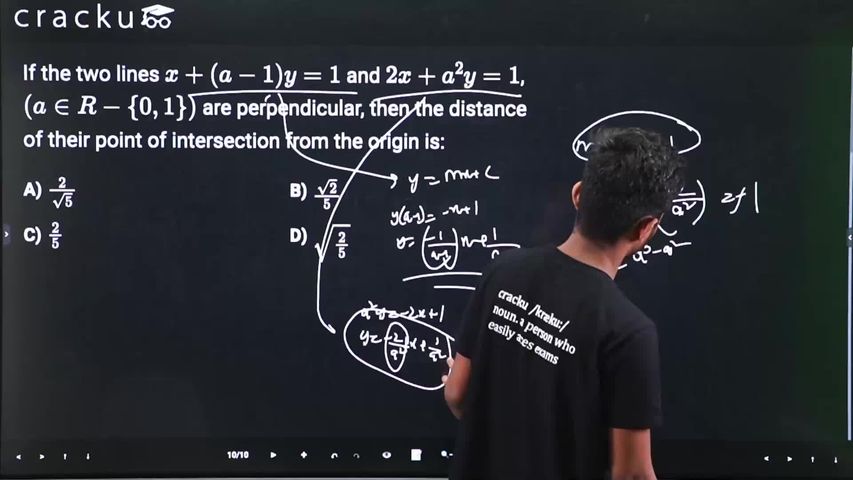
Click on the Email ☝️ to Watch the Video Solution
Create a FREE account and get:
_1.webp)

Educational materials for JEE preparation

Ask our AI anything

AI can make mistakes. Please verify important information.
AI can make mistakes. Please verify important information.


