
Join Our JEE Preparation Group
Prep with like-minded aspirants; Get access to free daily tests and study material.
Sign in
Please select an account to continue using cracku.in
↓ →
Join Our JEE Preparation Group
Prep with like-minded aspirants; Get access to free daily tests and study material.
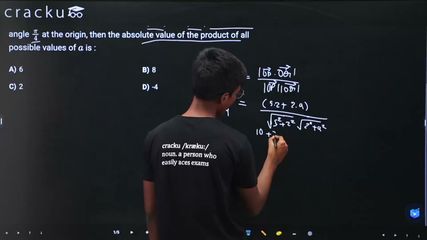
If the line segment joining the points $$(5, 2)$$ and $$(2, a)$$ subtends an angle $$\frac{\pi}{4}$$ at the origin, then the absolute value of the product of all possible values of $$a$$ is :
The line segment joining $$(5, 2)$$ and $$(2, a)$$ subtends an angle $$\frac{\pi}{4}$$ at the origin.
Let $$O = (0,0)$$, $$P = (5, 2)$$, $$Q = (2, a)$$.
$$\cos\frac{\pi}{4} = \frac{\vec{OP} \cdot \vec{OQ}}{|\vec{OP}||\vec{OQ}|}$$
$$\frac{1}{\sqrt{2}} = \frac{5(2) + 2(a)}{\sqrt{5^2 + 2^2} \cdot \sqrt{2^2 + a^2}} = \frac{10 + 2a}{\sqrt{29} \cdot \sqrt{4 + a^2}}$$
$$\frac{1}{2} = \frac{(10 + 2a)^2}{29(4 + a^2)}$$
$$29(4 + a^2) = 2(10 + 2a)^2$$
$$116 + 29a^2 = 2(100 + 40a + 4a^2) = 200 + 80a + 8a^2$$
$$21a^2 - 80a - 84 = 0$$
By Vieta's formulas for $$21a^2 - 80a - 84 = 0$$:
Sum of roots = $$\frac{80}{21}$$
Product of roots = $$\frac{-84}{21} = -4$$
Discriminant = $$80^2 + 4(21)(84) = 6400 + 7056 = 13456 = 116^2$$
$$a_1 = \frac{80 + 116}{42} = \frac{196}{42} = \frac{14}{3}, \quad a_2 = \frac{80 - 116}{42} = \frac{-36}{42} = -\frac{6}{7}$$
For both values: $$10 + 2a > 0$$, confirming the angle is in the correct range.
The product of all possible values of $$a$$ is $$\frac{14}{3} \times \left(-\frac{6}{7}\right) = -4$$.
Therefore, the answer is Option D: $$\mathbf{-4}$$.
Was this solution helpful?
Click on the Email ☝️ to Watch the Video Solution
Create a FREE account and get:
_1.webp)

Educational materials for JEE preparation

Ask our AI anything

AI can make mistakes. Please verify important information.
AI can make mistakes. Please verify important information.
