
Join Our JEE Preparation Group
Prep with like-minded aspirants; Get access to free daily tests and study material.
Sign in
Please select an account to continue using cracku.in
↓ →
Join Our JEE Preparation Group
Prep with like-minded aspirants; Get access to free daily tests and study material.
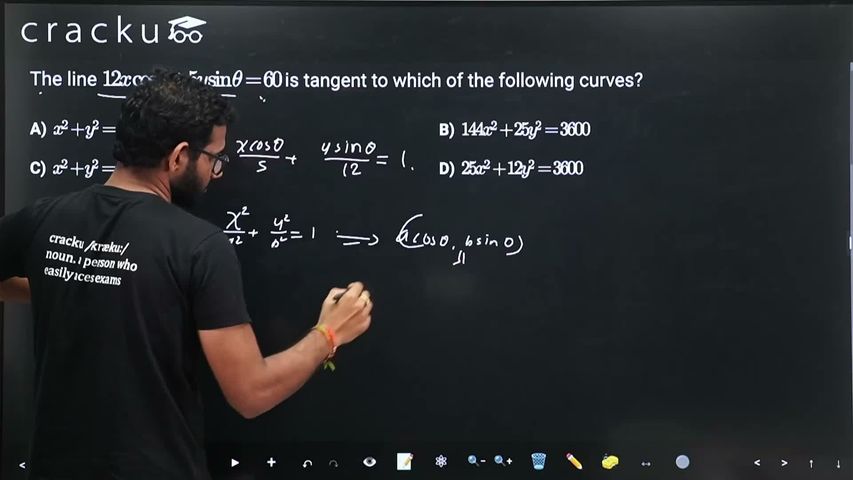
The line $$12x\cos\theta + 5y\sin\theta = 60$$ is tangent to which of the following curves?
We are given the straight line
$$12x\cos\theta \;+\; 5y\sin\theta \;=\; 60.$$
Our task is to decide which one of the four given curves has this line as a tangent (for some value of the parameter $$\theta$$). To see this clearly we first put the equation of the line in a form that can be compared with the standard tangent form of conic sections.
Dividing every term by $$60$$ we get
$$\frac{12x\cos\theta}{60} \;+\; \frac{5y\sin\theta}{60} \;=\; 1.$$
Reducing the fractions step by step,
$$\frac{12}{60} \;=\; \frac{1}{5}, \qquad \frac{5}{60} \;=\; \frac{1}{12},$$
so the equation becomes
$$\frac{x\cos\theta}{5} \;+\; \frac{y\sin\theta}{12} \;=\; 1.$$
Now we recall the standard result for an ellipse. For the ellipse whose equation is
$$\frac{x^{2}}{a^{2}} \;+\; \frac{y^{2}}{b^{2}} \;=\; 1,$$
the equation of a tangent at the point $$\bigl(a\cos\phi,\;b\sin\phi\bigr)$$ on the ellipse is
$$\frac{x\cos\phi}{a} \;+\; \frac{y\sin\phi}{b} \;=\; 1.$$
Comparing our rearranged line
$$\frac{x\cos\theta}{5} \;+\; \frac{y\sin\theta}{12} \;=\; 1$$
term by term with the general tangent form
$$\frac{x\cos\phi}{a} \;+\; \frac{y\sin\phi}{b} \;=\; 1,$$
we see an exact match when we identify
$$a \;=\; 5, \qquad b \;=\; 12.$$
Hence the curve whose tangents are described by the given family of lines is the ellipse
$$\frac{x^{2}}{5^{2}} \;+\; \frac{y^{2}}{12^{2}} \;=\; 1,$$
that is,
$$\frac{x^{2}}{25} \;+\; \frac{y^{2}}{144} \;=\; 1.$$
To place this ellipse in the exact form used in the options, we clear denominators by multiplying every term by the least common multiple $$25 \times 144 = 3600$$:
$$144x^{2} \;+\; 25y^{2} \;=\; 3600.$$
This matches Option B exactly.
Hence, the correct answer is Option B.
Click on the Email ☝️ to Watch the Video Solution
Create a FREE account and get:
_1.webp)

Educational materials for JEE preparation

Ask our AI anything

AI can make mistakes. Please verify important information.
AI can make mistakes. Please verify important information.


