
Join Our JEE Preparation Group
Prep with like-minded aspirants; Get access to free daily tests and study material.
Sign in
Please select an account to continue using cracku.in
↓ →
Join Our JEE Preparation Group
Prep with like-minded aspirants; Get access to free daily tests and study material.
The correct increasing order of C - H(A), C - 0 (B), C = O(C) and C ≡ N (D) bonds in terms of covalent bond length is :
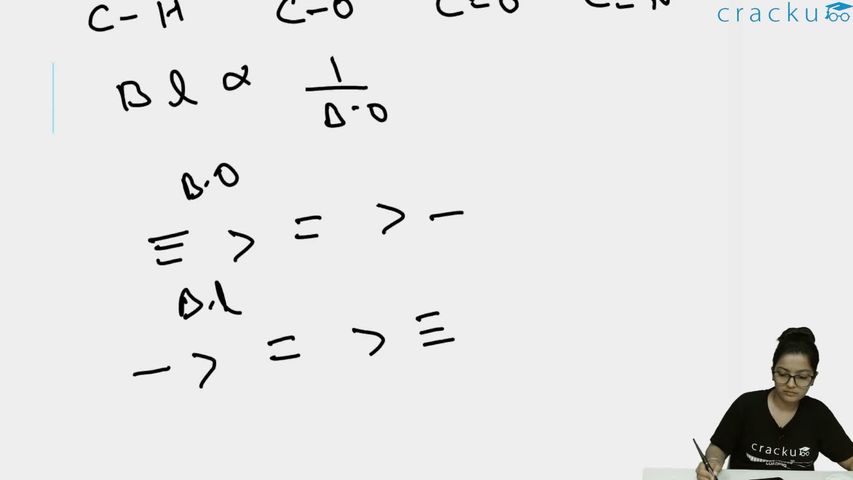
The covalent bond length depends mainly on two factors:
• bond order (greater bond order → shorter bond)
• size of the atoms involved (bond with a smaller atom is shorter).
Typical experimental bond lengths (in Å) are frequently quoted as
$$\begin{aligned} \text{C-H (single)} & : 1.09 \; \text{Å} \\[2pt] \text{C}\equiv\text{N (triple)} & : 1.16 \; \text{Å} \\[2pt] \text{C}=\text{O (double)} & : 1.21 \; \text{Å} \\[2pt] \text{C-O (single)} & : 1.43 \; \text{Å} \end{aligned}$$
Arranging these values from the shortest bond (smallest length) to the longest bond (largest length):
$$\text{C-H} \lt \text{C}\equiv\text{N} \lt \text{C}=\text{O} \lt \text{C-O}$$
Using the labels given in the question:
(A) C-H, (D) C≡N, (C) C=O, (B) C-O
The increasing order of covalent bond length is therefore
$$A \lt D \lt C \lt B$$
Hence the correct option is Option A.
Was this solution helpful?
Click on the Email ☝️ to Watch the Video Solution
Create a FREE account and get:
_1.webp)

Educational materials for JEE preparation

Ask our AI anything

AI can make mistakes. Please verify important information.
AI can make mistakes. Please verify important information.
