
Join Our JEE Preparation Group
Prep with like-minded aspirants; Get access to free daily tests and study material.
Sign in
Please select an account to continue using cracku.in
↓ →
Join Our JEE Preparation Group
Prep with like-minded aspirants; Get access to free daily tests and study material.
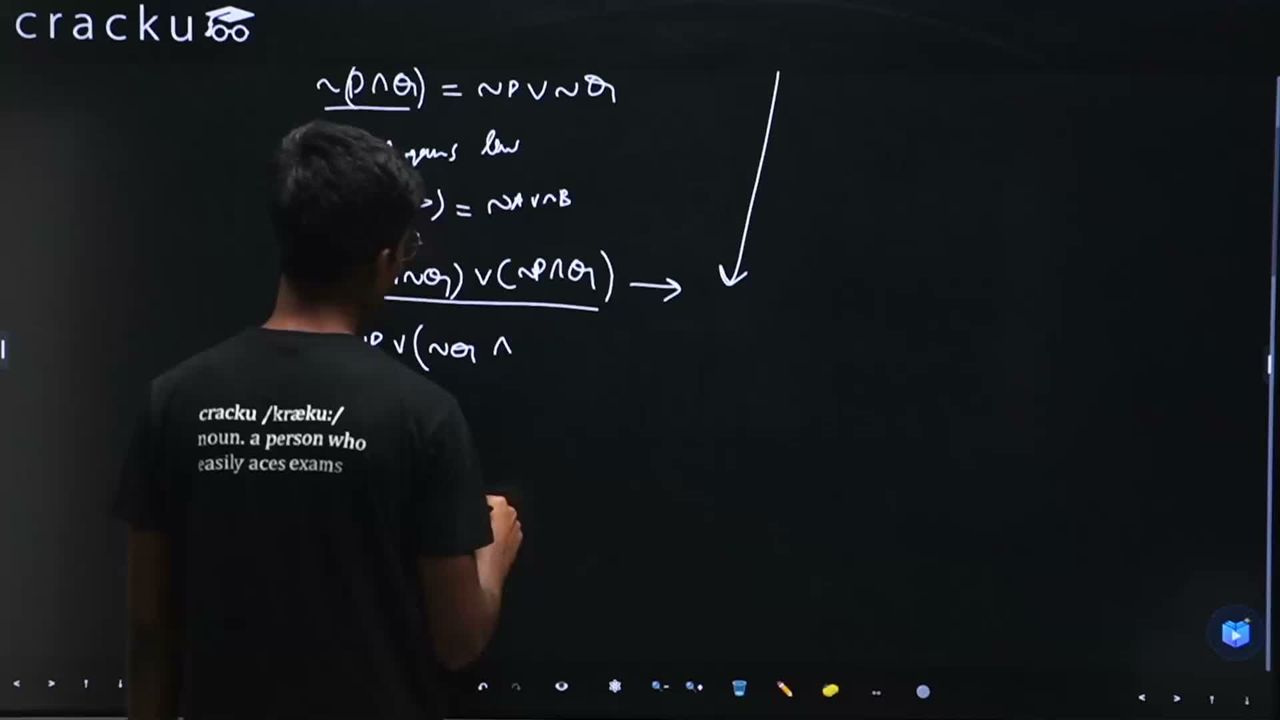
The compound statement $$(\sim(P \wedge Q)) \vee ((\sim P) \wedge Q) \Rightarrow ((\sim P) \wedge (\sim Q))$$ is equivalent to
The compound statement $$(\sim(P \wedge Q)) \vee ((\sim P) \wedge Q) \Rightarrow ((\sim P) \wedge (\sim Q))$$ is equivalent to what?
By De Morgan's law, $$\sim(P \wedge Q) = \sim P \vee \sim Q$$, so the antecedent becomes $$(\sim P \vee \sim Q) \vee (\sim P \wedge Q).$$
Let $$A = \sim P, B = \sim Q$$. Then the antecedent is $$(A \vee B) \vee (A \wedge \sim B).$$ If $$A = T$$, this expression is true regardless of $$B$$. If $$A = F$$, then $$(F \vee B) \vee (F \wedge \sim B) = B \vee F = B$$. Hence the antecedent simplifies to $$A \vee B = \sim P \vee \sim Q$$.
The full statement thus becomes $$(\sim P \vee \sim Q) \Rightarrow (\sim P \wedge \sim Q)$$. Using $$p \Rightarrow q \equiv \sim p \vee q$$, this is $$\sim(\sim P \vee \sim Q) \vee (\sim P \wedge \sim Q) = (P \wedge Q) \vee (\sim P \wedge \sim Q).$$
This last expression is the biconditional $$P \Leftrightarrow Q = (\sim P \vee Q) \wedge (\sim Q \vee P).$$
The correct answer is Option 1: $$((\sim P) \vee Q) \wedge ((\sim Q) \vee P)$$.
Was this solution helpful?
Click on the Email ☝️ to Watch the Video Solution
Create a FREE account and get:
_1.webp)

Educational materials for JEE preparation

Ask our AI anything

AI can make mistakes. Please verify important information.
AI can make mistakes. Please verify important information.
