
Join Our JEE Preparation Group
Prep with like-minded aspirants; Get access to free daily tests and study material.
Sign in
Please select an account to continue using cracku.in
↓ →
Join Our JEE Preparation Group
Prep with like-minded aspirants; Get access to free daily tests and study material.
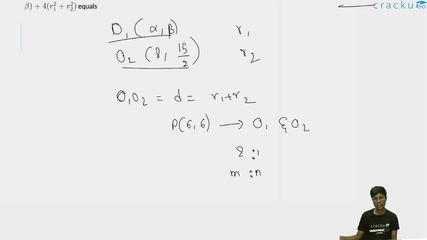
Let the circles $$C_1 : (x - \alpha)^2 + (y - \beta)^2 = r_1^2$$ and $$C_2 : (x - 8)^2 + \left(y - \frac{15}{2}\right)^2 = r_2^2$$ touch each other externally at the point $$(6, 6)$$. If the point $$(6, 6)$$ divides the line segment joining the centres of the circles $$C_1$$ and $$C_2$$ internally in the ratio $$2 : 1$$, then $$(\alpha + \beta) + 4(r_1^2 + r_2^2)$$ equals
The centres of the two circles are
$$C_1(\alpha ,\beta) \quad\text{and}\quad C_2\left(8,\frac{15}{2}\right).$$
Given that the point $$P(6,6)$$ divides the line segment $$C_1C_2$$ internally in the ratio $$2:1$$, we use the section (internal‐division) formula.
If $$P(x_P,y_P)$$ divides $$A(x_A,y_A)$$ and $$B(x_B,y_B)$$ so that $$AP:PB = m:n$$, then
$$x_P = \frac{n\,x_A + m\,x_B}{m+n}, \qquad
y_P = \frac{n\,y_A + m\,y_B}{m+n}.$$
Here $$m=2,\; n=1,\; A\equiv C_1(\alpha,\beta),\; B\equiv C_2\left(8,\frac{15}{2}\right).$$
Applying the formula to the $$x$$-coordinate:
$$6 = x_P = \frac{1\cdot \alpha + 2\cdot 8}{2+1}
= \frac{\alpha + 16}{3}$$
$$\Rightarrow \alpha + 16 = 18
\;\Rightarrow\; \alpha = 2.$$
Applying the formula to the $$y$$-coordinate:
$$6 = y_P = \frac{1\cdot \beta + 2\left(\dfrac{15}{2}\right)}{3}
= \frac{\beta + 15}{3}$$
$$\Rightarrow \beta + 15 = 18
\;\Rightarrow\; \beta = 3.$$
Thus
$$C_1(2,3),\quad C_2\left(8,\frac{15}{2}\right).$$
The point $$P(6,6)$$ is the common point of contact, so it lies on both circles:
Radius of $$C_1$$:
$$r_1 = \sqrt{(6-2)^2 + (6-3)^2}
= \sqrt{4^2 + 3^2}
= \sqrt{25}
= 5,$$
$$\therefore\; r_1^{2}=25.$$
Radius of $$C_2$$:
$$r_2 = \sqrt{(6-8)^2 + \left(6-\frac{15}{2}\right)^2}
= \sqrt{(-2)^2 + \left(-\frac{3}{2}\right)^2}
= \sqrt{4 + \frac{9}{4}}
= \sqrt{\frac{25}{4}}
= \frac{5}{2},$$
$$\therefore\; r_2^{2} = \frac{25}{4}.$$
Finally, evaluate the required expression:
$$(\alpha + \beta) + 4\left(r_1^{2} + r_2^{2}\right)
= (2 + 3) + 4\left(25 + \frac{25}{4}\right).$$
Inside the brackets:
$$25 + \frac{25}{4} = \frac{100}{4} + \frac{25}{4}
= \frac{125}{4}.$$
Multiplying by 4 gives $$125$$, so
$$(\alpha + \beta) + 4(r_1^{2} + r_2^{2}) = 5 + 125 = 130.$$
The value is 130, which matches Option B.
Was this solution helpful?
Click on the Email ☝️ to Watch the Video Solution
Create a FREE account and get:
_1.webp)

Educational materials for JEE preparation

Ask our AI anything

AI can make mistakes. Please verify important information.
AI can make mistakes. Please verify important information.
