
Join Our JEE Preparation Group
Prep with like-minded aspirants; Get access to free daily tests and study material.
Sign in
Please select an account to continue using cracku.in
↓ →
Join Our JEE Preparation Group
Prep with like-minded aspirants; Get access to free daily tests and study material.
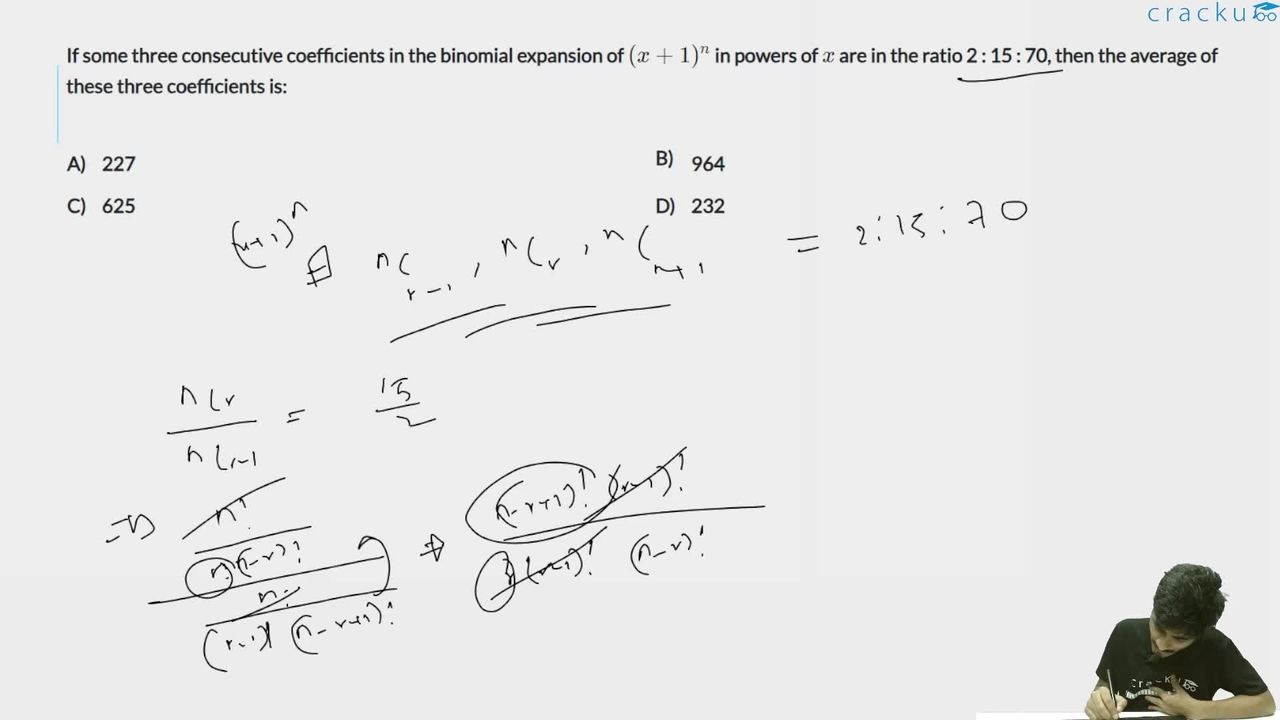
If some three consecutive coefficients in the binomial expansion of $$(x + 1)^n$$ in powers of $$x$$ are in the ratio 2 : 15 : 70, then the average of these three coefficients is:
We consider the binomial expansion $$ (x+1)^n = \sum_{k=0}^{n} \binom{n}{k} x^{\,k}. $$
The coefficient of $$x^{\,k}$$ is $$\binom{n}{k}.$$ Three consecutive coefficients will therefore be $$ \binom{n}{r-1}, \; \binom{n}{r}, \; \binom{n}{r+1} $$ for some integer $$r$$ with $$1\le r\le n-1.$$
According to the question, these three coefficients are in the ratio $$2:15:70.$$ So we can write
$$ \frac{\binom{n}{r}}{\binom{n}{r-1}}=\frac{15}{2}, \qquad \frac{\binom{n}{r+1}}{\binom{n}{r}}=\frac{70}{15}=\frac{14}{3}. $$
First we recall the standard identity connecting consecutive binomial coefficients:
Formula: $$ \frac{\binom{n}{k}}{\binom{n}{k-1}}=\frac{n-k+1}{k}. $$
Applying this to the first ratio with $$k=r,$$ we get
$$ \frac{\binom{n}{r}}{\binom{n}{r-1}} =\frac{n-r+1}{r}. $$
Set this equal to $$15/2$$ as required by the given ratio:
$$ \frac{n-r+1}{r}=\frac{15}{2}. $$
Cross-multiplying,
$$ 2(n-r+1)=15r, $$
$$ 2n-2r+2=15r, $$
$$ 2n = 17r-2, $$
$$ n = \frac{17r-2}{2}. $$
For $$n$$ to be an integer, $$17r-2$$ must be even. Because 17 is odd, $$r$$ itself must be even. Let us put $$r=2k$$ where $$k$$ is a positive integer.
Substituting $$r=2k$$ in the expression for $$n$$ we obtain
$$ n = \frac{17(2k)-2}{2}=\frac{34k-2}{2}=17k-1. $$
Now we turn to the second ratio. Using the same identity with $$k=r+1,$$ we have
$$ \frac{\binom{n}{r+1}}{\binom{n}{r}} =\frac{n-(r+1)+1}{r+1} =\frac{n-r}{r+1}. $$
This must equal $$\dfrac{14}{3}.$$ Therefore
$$ \frac{n-r}{r+1}=\frac{14}{3}. $$
Substituting the earlier expressions $$n=17k-1$$ and $$r=2k,$$ we get
$$ \frac{(17k-1)-2k}{2k+1}=\frac{14}{3}, $$
$$ \frac{15k-1}{2k+1}=\frac{14}{3}. $$
Cross-multiplying once more,
$$ 3(15k-1)=14(2k+1), $$
$$ 45k-3=28k+14, $$
$$ 45k-28k=14+3, $$
$$ 17k = 17, $$
$$ k = 1. $$
Putting $$k=1$$ back, we obtain
$$ r = 2k = 2, \qquad n = 17k-1 = 16. $$
Thus the three required coefficients are
$$ \binom{16}{1},\; \binom{16}{2},\; \binom{16}{3}. $$
We evaluate them one by one:
$$ \binom{16}{1}=16, $$
$$ \binom{16}{2}=\frac{16\cdot15}{2}=120, $$
$$ \binom{16}{3}=\frac{16\cdot15\cdot14}{3\cdot2\cdot1}=560. $$
The three numbers $$16,\,120,\,560$$ are indeed in the ratio $$2:15:70$$ (dividing each by 8 confirms this).
The average (arithmetic mean) of these three coefficients is
$$ \text{Average}=\frac{16+120+560}{3}=\frac{696}{3}=232. $$
Hence, the correct answer is Option D.
Was this solution helpful?
Click on the Email ☝️ to Watch the Video Solution
Create a FREE account and get:
_1.webp)

Educational materials for JEE preparation

Ask our AI anything

AI can make mistakes. Please verify important information.
AI can make mistakes. Please verify important information.


