
Join Our JEE Preparation Group
Prep with like-minded aspirants; Get access to free daily tests and study material.
Sign in
Please select an account to continue using cracku.in
↓ →
Join Our JEE Preparation Group
Prep with like-minded aspirants; Get access to free daily tests and study material.
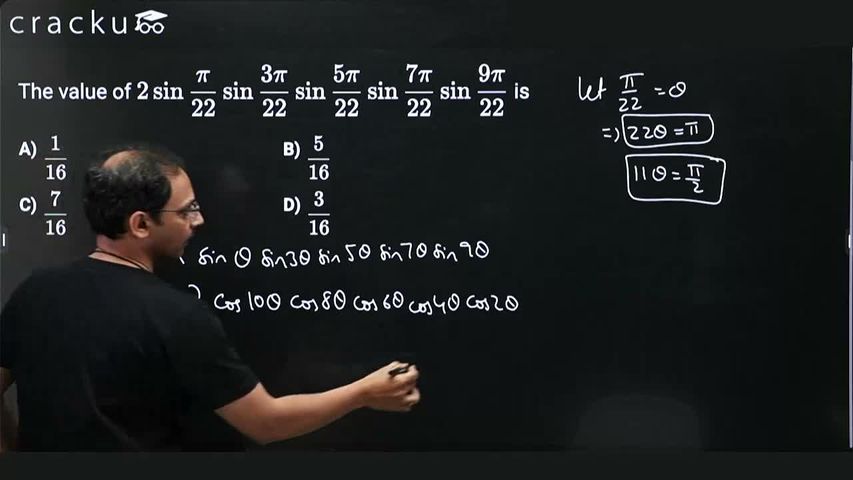
The value of $$2\sin\dfrac{\pi}{22} \sin\dfrac{3\pi}{22} \sin\dfrac{5\pi}{22} \sin\dfrac{7\pi}{22} \sin\dfrac{9\pi}{22}$$ is
We need to evaluate $$2\sin\dfrac{\pi}{22}\sin\dfrac{3\pi}{22}\sin\dfrac{5\pi}{22}\sin\dfrac{7\pi}{22}\sin\dfrac{9\pi}{22}$$.
The angles here are of the form $$(2k-1)\pi/22$$ for $$k=1,2,3,4,5$$, and since $$22=2\times11$$ these can be viewed as $$(2k-1)\pi/(2\cdot11)\,$$.
Although there is a standard product identity for a positive integer $$n$$, namely
$$\prod_{k=1}^{n}\sin\dfrac{(2k-1)\pi}{4n} \;=\;\dfrac{\sqrt{2}}{2^n},$$
it does not directly apply here because our denominator is $$2\cdot11$$ rather than $$4n$$. Instead we use the identity valid for odd $$m$$,
$$\prod_{k=0}^{\frac{m-1}{2}-1}\sin\dfrac{(2k+1)\pi}{2m} \;=\;\dfrac{1}{2^{(m-1)/2}}.$$
Setting $$m=11$$ gives $$(m-1)/2=5$$, so
$$\sin\dfrac{\pi}{22}\,\sin\dfrac{3\pi}{22}\,\sin\dfrac{5\pi}{22}\,\sin\dfrac{7\pi}{22}\,\sin\dfrac{9\pi}{22} \;=\;\dfrac{1}{2^5}\;=\;\dfrac{1}{32}.\!$$
This evaluation can also be confirmed by examining the Chebyshev polynomial $$U_{10}(x)$$, since $$U_{10}(\cos\theta)=\dfrac{\sin(11\theta)}{\sin\theta}$$ has roots at $$x=\cos\frac{k\pi}{11}$$ for $$k=1,2,\dots,10$$ and leading coefficient $$2^{10}$$. The factorization of $$U_{10}$$ yields the same product of odd‐indexed sines as $$1/32$$.
Finally, multiplying by 2 gives $$2\times\dfrac{1}{32}=\dfrac{1}{16}\,$$, so the correct answer is Option A: $$\dfrac{1}{16}$$.
Was this solution helpful?
Click on the Email ☝️ to Watch the Video Solution
Create a FREE account and get:
_1.webp)

Educational materials for JEE preparation

Ask our AI anything

AI can make mistakes. Please verify important information.
AI can make mistakes. Please verify important information.
