
Join Our JEE Preparation Group
Prep with like-minded aspirants; Get access to free daily tests and study material.
Sign in
Please select an account to continue using cracku.in
↓ →
Join Our JEE Preparation Group
Prep with like-minded aspirants; Get access to free daily tests and study material.
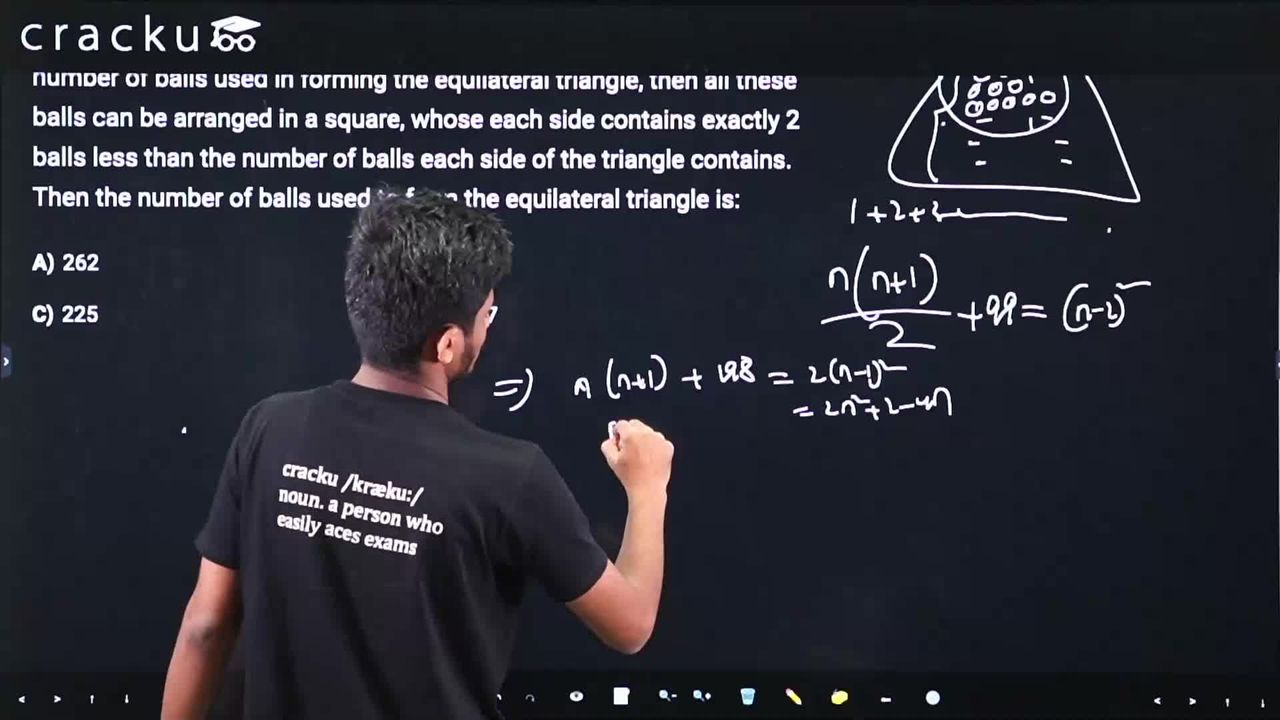
Some identical balls are arranged in rows to form an equilateral triangle. The first row consists of one ball, the second row consists of two balls and so on. If 99 more identical balls are added to the total number of balls used in forming the equilateral triangle, then all these balls can be arranged in a square, whose each side contains exactly 2 balls less than the number of balls each side of the triangle contains. Then the number of balls used to form the equilateral triangle is:
We have balls first arranged in the shape of an equilateral triangle whose side has $$n$$ balls. In such an arrangement the rows contain $$1,2,3,\ldots ,n$$ balls respectively. The total number of balls in an equilateral triangular arrangement of side $$n$$ is known to be the $$n^{\text{th}}$$ triangular number. The formula for the sum of the first $$n$$ natural numbers is
$$T_n=\frac{n(n+1)}{2}.$$
So, the number of balls actually used in making the triangle is
$$\text{(balls in triangle)}=\frac{n(n+1)}{2}.$$
According to the problem, if we now add exactly $$99$$ more identical balls to this collection, the enlarged collection can be perfectly rearranged into a square. Further, each side of this square has exactly $$2$$ balls fewer than each side of the original triangle. Since each side of the triangle already contains $$n$$ balls, each side of the square must therefore contain $$n-2$$ balls.
The number of balls needed to build such a square is the square of the number of balls along one side. Hence
$$\text{(balls in square)}=(n-2)^2.$$
The balls in the square come from all the balls of the triangle plus the additional $$99$$ balls. Therefore we can write the equality
$$\frac{n(n+1)}{2}+99=(n-2)^2.$$
Now we solve this equation step by step. First multiply every term by $$2$$ to clear the denominator:
$$n(n+1)+198=2(n-2)^2.$$
Expand both sides. On the left:
$$n(n+1)=n^2+n,$$
so the left-hand side becomes $$n^2+n+198.$$ On the right, start with the binomial square:
$$(n-2)^2=n^2-4n+4,$$
then double it:
$$2(n-2)^2=2(n^2-4n+4)=2n^2-8n+8.$$
Hence the equality is now
$$n^2+n+198=2n^2-8n+8.$$
Bring every term to one side to obtain zero on the other side. Subtract the entire left-hand side from both sides:
$$0=2n^2-8n+8-(n^2+n+198).$$
Carry out the subtractions term by term:
$$0=2n^2-n^2-8n-n+8-198,$$
which simplifies to
$$0=n^2-9n-190.$$
So we must solve the quadratic equation
$$n^2-9n-190=0.$$
The quadratic formula for $$ax^2+bx+c=0$$ is $$x=\dfrac{-b\pm\sqrt{b^2-4ac}}{2a}.$$ Here $$a=1,\;b=-9,\;c=-190$$. First compute the discriminant:
$$\Delta=b^2-4ac=(-9)^2-4(1)(-190)=81+760=841.$$
Since $$\sqrt{841}=29,$$ we now have
$$n=\frac{-(-9)\pm29}{2(1)}=\frac{9\pm29}{2}.$$
This gives two possible values:
$$n=\frac{9+29}{2}=19\qquad\text{or}\qquad n=\frac{9-29}{2}=-10.$$
Because $$n$$ counts balls along a side, it must be positive, so we discard $$n=-10$$ and keep
$$n=19.$$
Now substitute back to find the actual number of balls in the original triangular arrangement:
$$\text{Balls in triangle}=T_{19}=\frac{19(19+1)}{2}=\frac{19\cdot20}{2}=190.$$
So, the triangle was made of $$190$$ balls.
Hence, the correct answer is Option B.
Was this solution helpful?
Click on the Email ☝️ to Watch the Video Solution
Create a FREE account and get:
_1.webp)

Educational materials for JEE preparation

Ask our AI anything

AI can make mistakes. Please verify important information.
AI can make mistakes. Please verify important information.


