
Join Our JEE Preparation Group
Prep with like-minded aspirants; Get access to free daily tests and study material.
Sign in
Please select an account to continue using cracku.in
↓ →
Join Our JEE Preparation Group
Prep with like-minded aspirants; Get access to free daily tests and study material.
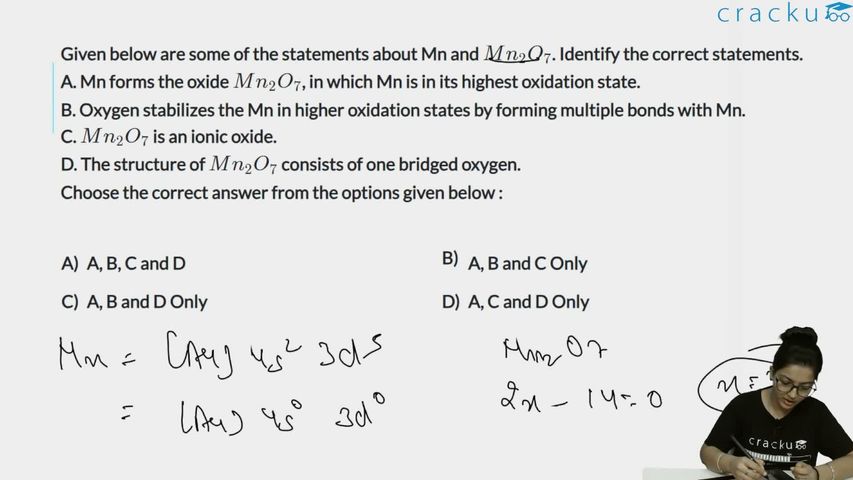
Given below are some of the statements about Mn and $$Mn_{2}O_{7}$$. Identify the correct statements.
A. Mn forms the oxide $$Mn_{2}O_{7}$$, in which Mn is in its highest oxidation state.
B. Oxygen stabilizes the Mn in higher oxidation states by forming multiple bonds with Mn.
C. $$Mn_{2}O_{7}$$ is an ionic oxide.
D. The structure of $$Mn_{2}O_{7}$$ consists of one bridged oxygen.
Choose the correct answer from the options given below :
We need to identify which statements about Mn and $$Mn_2O_7$$ are correct.
In $$Mn_2O_7$$, let the oxidation state of Mn be $$x$$. Since the compound is neutral and each oxygen is $$-2$$, we have $$ 2x + 7(-2) = 0 \implies 2x = 14 \implies x = +7. $$ The maximum oxidation state of Mn (atomic number 25, configuration $$[Ar]3d^5 4s^2$$) is +7, corresponding to the loss of all seven valence electrons (five from 3d and two from 4s). Therefore, Statement A is correct.
Oxygen, being a small and highly electronegative atom, can form $$p\pi - d\pi$$ multiple bonds with transition metals. These multiple bonds help stabilize high oxidation states by accepting electron density from the metal through $$\pi$$-bonding. In $$Mn_2O_7$$, the Mn=O double bonds stabilize the +7 oxidation state, so Statement B is correct.
Statement C claims that $$Mn_2O_7$$ is an ionic oxide; this is incorrect. When a metal is in a very high oxidation state (+7), it has high polarizing power (high charge, small size), which leads to significant covalent character according to Fajans' rules. $$Mn_2O_7$$ is a dark green, oily liquid that is explosive—properties characteristic of a covalent compound rather than an ionic one. It is also an acidic oxide, forming permanganic acid $$HMnO_4$$ with water.
The structure of $$Mn_2O_7$$ consists of two $$MnO_3$$ units connected by a single bridging oxygen atom (Mn-O-Mn). Each Mn atom is tetrahedrally coordinated with three terminal oxygen atoms and one bridging oxygen atom, making Statement D correct.
The correct statements are A, B, and D. Hence, the correct answer is Option (3): A, B and D Only.
Was this solution helpful?
Click on the Email ☝️ to Watch the Video Solution
Create a FREE account and get:
_1.webp)

Educational materials for JEE preparation

Ask our AI anything

AI can make mistakes. Please verify important information.
AI can make mistakes. Please verify important information.
