Join Our JEE Preparation Group
Prep with like-minded aspirants; Get access to free daily tests and study material.
Sign in
Please select an account to continue using cracku.in
↓ →
Join Our JEE Preparation Group
Prep with like-minded aspirants; Get access to free daily tests and study material.
An α-amino acid contains two main acid-base centres:
• the carboxylic group $${-COOH}$$ with $$pK_a \approx 2$$ (behaves as an acid)
• the amino group $${-NH_2}$$ with $$pK_a \approx 9.5$$ (behaves as a base)
General protonation rule: the group is protonated when $$\text{pH} \lt pK_a$$ and de-protonated when $$\text{pH} \gt pK_a$$.
Case 1:
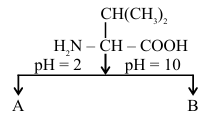
$$\text{pH}=2$$ is lower than the amino group’s $$pK_a$$ but equal to the carboxyl group’s $$pK_a$$.
• Carboxyl group: at (or just below) its $$pK_a$$ it stays protonated as $$-COOH$$.
• Amino group: since $$2 \lt 9.5$$ it is fully protonated to $$-NH_3^+$$.
Therefore structure $$A$$ is $$H_3^+N-CH\bigl(CH(CH_3)_2\bigr)-COOH$$, written shortly as $$H_3^+N-CH-COOH$$.
Case 2:
$$\text{pH}=10$$ is higher than both $$pK_a$$ values.
• Carboxyl group: $$10 \gt 2$$ ⇒ completely de-protonated to $$-COO^-$$.
• Amino group: $$10 \gt 9.5$$ ⇒ largely de-protonated to the neutral $$-NH_2$$ form.
Hence structure $$B$$ is $$H_2N-CH\bigl(CH(CH_3)_2\bigr)-COO^-$$, written briefly as $$H_2N-CH-COO^-$$.
Comparing with the given options:
Option A A = $$H_3^+N-CH-COOH$$, B = $$H_2N-CH-COO^-$$
This matches the derived forms.
So, the correct choice is Option A.
Was this solution helpful?
Create a FREE account and get:
_1.webp)

Educational materials for JEE preparation

Ask our AI anything

AI can make mistakes. Please verify important information.
AI can make mistakes. Please verify important information.