
Join Our JEE Preparation Group
Prep with like-minded aspirants; Get access to free daily tests and study material.
Sign in
Please select an account to continue using cracku.in
↓ →
Join Our JEE Preparation Group
Prep with like-minded aspirants; Get access to free daily tests and study material.
Let $$\alpha = \dfrac{(4!)!}{(4!)^{3!}}$$ and $$\beta = \dfrac{(5!)!}{(5!)^{4!}}$$. Then :
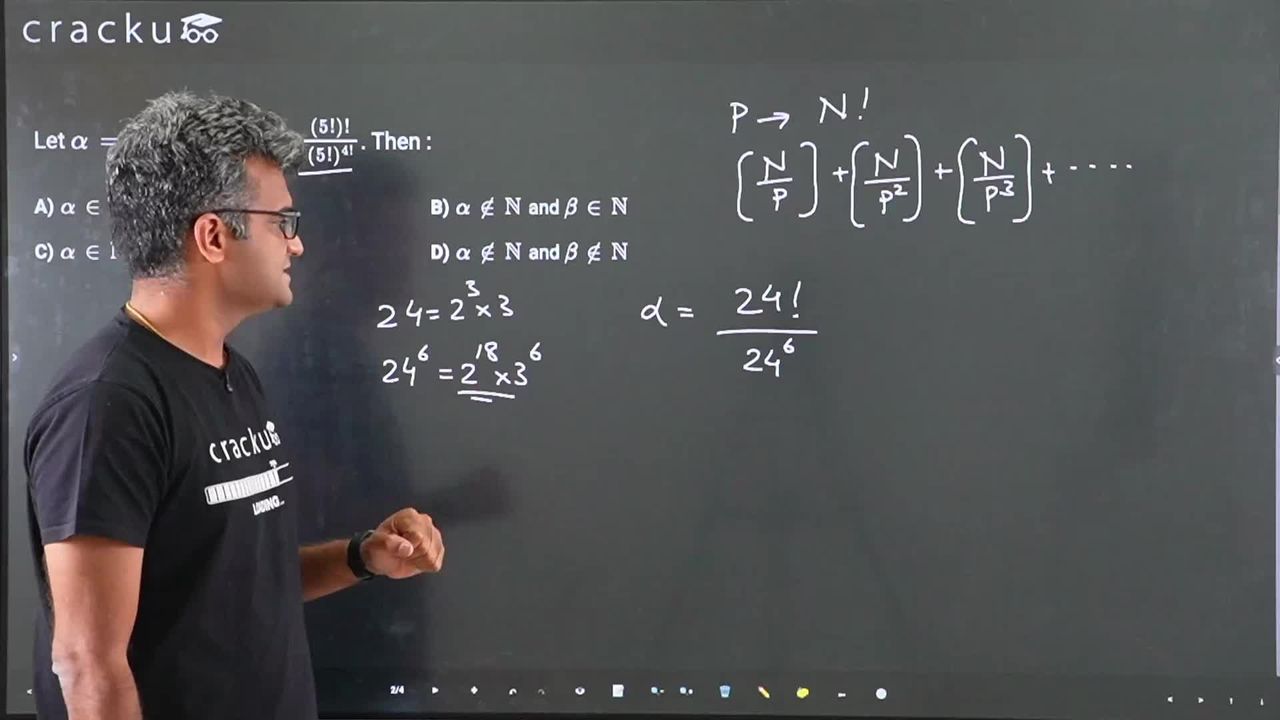
We have, $$4!=24$$, $$5!=120$$, and $$3!=6$$
Therefore,
$$\alpha = \dfrac{24!}{24^6}$$ and $$\beta = \dfrac{120!}{120^{24}}$$
Or
$$\alpha = \dfrac{24!}{2^{18}\times 3^6}$$ and $$\beta = \dfrac{120!}{2^{72}\times 3^{24}\times 5^{24}}$$
In order for $$\alpha$$ to be an integer, $$24!$$ must contain $$2^{18}$$ and $$3^6$$
The highest power of $$2$$ in $$24!$$ is $$\lfloor \dfrac{24}{2} \rfloor + \lfloor \dfrac{24}{4} \rfloor + \lfloor \dfrac{24}{8} \rfloor + \lfloor \dfrac{24}{16} \rfloor + \dots = 12+6+3+1= 22$$ which is larger than $$18$$
Similarly, the highest power of $$3$$ in $$24!$$ is larger than $$6$$.
Thus, $$\alpha \in \mathbb{N}$$
In $$\beta$$, in order for $$\beta$$ to be an integer, $$120!$$ must contain $$2^{72}$$, $$3^{24}$$, and $$5^{24}$$
The highest power of $$2$$ in $$120!$$ is $$60+30+15+7+3+1= 116$$, which is larger than $$72$$. The highest power of $$3$$ in $$120!$$ is $$40+13+4+1= 58$$, which is also larger than $$24$$. The highest power of $$5$$ in $$120!$$ is $$24+4= 28$$, which is larger than $$2$$.
Thus, $$\beta \in \mathbb{N}$$
Option C is the correct answer.
Was this solution helpful?
Click on the Email ☝️ to Watch the Video Solution
Create a FREE account and get:
_1.webp)

Educational materials for JEE preparation

Ask our AI anything

AI can make mistakes. Please verify important information.
AI can make mistakes. Please verify important information.
