
Join Our JEE Preparation Group
Prep with like-minded aspirants; Get access to free daily tests and study material.
Sign in
Please select an account to continue using cracku.in
↓ →
Join Our JEE Preparation Group
Prep with like-minded aspirants; Get access to free daily tests and study material.
The sum of 10 terms of the series $$\frac{3}{1^2 \times 2^2} + \frac{5}{2^2 \times 3^2} + \frac{7}{3^2 \times 4^2} + \ldots$$ is:
We have the series
$$\frac{3}{1^2\times2^2}+\frac{5}{2^2\times3^2}+\frac{7}{3^2\times4^2}+\ldots$$
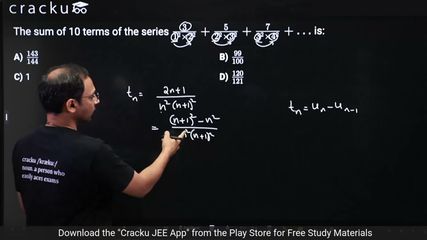
To add the first ten terms, we first write a general term. For the $$n^{\text{th}}$$ term the numerator is $$3,5,7,\ldots$$, which forms the sequence $$2n+1$$ for $$n=1,2,3,\ldots$$. The denominator for the $$n^{\text{th}}$$ term is $$1^2\!\times\!2^2$$, $$2^2\!\times\!3^2$$, $$\ldots$$, i.e. $$n^{2}(n+1)^{2}$$. So the general term $$T_n$$ is
$$T_n=\frac{2n+1}{n^{2}(n+1)^{2}}\qquad(n=1,2,3,\ldots).$$
Now we look for a way to split this fraction so that a telescoping sum appears. Recall the algebraic identity
$$\frac1{n^{2}}-\frac1{(n+1)^{2}} =\frac{(n+1)^{2}-n^{2}}{n^{2}(n+1)^{2}} =\frac{n^{2}+2n+1-n^{2}}{n^{2}(n+1)^{2}} =\frac{2n+1}{n^{2}(n+1)^{2}}.$$
The right‐hand side is exactly $$T_n$$. Hence we can write
$$T_n=\frac1{n^{2}}-\frac1{(n+1)^{2}}.$$
This form is ideal for telescoping. Let $$S_{10}$$ denote the sum of the first $$10$$ terms:
$$\begin{aligned} S_{10} &=\sum_{n=1}^{10}T_n =\sum_{n=1}^{10}\left(\frac1{n^{2}}-\frac1{(n+1)^{2}}\right).\\[4pt] \end{aligned}$$
We now write out the terms explicitly to see the cancellation:
$$\begin{aligned} S_{10}&=\Bigl(\frac1{1^{2}}-\frac1{2^{2}}\Bigr) +\Bigl(\frac1{2^{2}}-\frac1{3^{2}}\Bigr) +\Bigl(\frac1{3^{2}}-\frac1{4^{2}}\Bigr) +\cdots +\Bigl(\frac1{10^{2}}-\frac1{11^{2}}\Bigr).\\[4pt] \end{aligned}$$
Inside the sum each $$\displaystyle -\frac1{k^{2}}$$ term cancels with the $$\displaystyle +\frac1{k^{2}}$$ term that comes just after it. After all cancellations only the very first positive term $$\displaystyle \frac1{1^{2}}$$ and the very last negative term $$\displaystyle -\frac1{11^{2}}$$ remain:
$$S_{10}=\frac1{1^{2}}-\frac1{11^{2}} =1-\frac1{121}.$$
Combining the fractions gives
$$S_{10}=\frac{121-1}{121} =\frac{120}{121}.$$
Hence, the correct answer is Option D.
Click on the Email ☝️ to Watch the Video Solution
Create a FREE account and get:
_1.webp)

Educational materials for JEE preparation

Ask our AI anything

AI can make mistakes. Please verify important information.
AI can make mistakes. Please verify important information.


