
Join Our JEE Preparation Group
Prep with like-minded aspirants; Get access to free daily tests and study material.
Sign in
Please select an account to continue using cracku.in
↓ →
Join Our JEE Preparation Group
Prep with like-minded aspirants; Get access to free daily tests and study material.
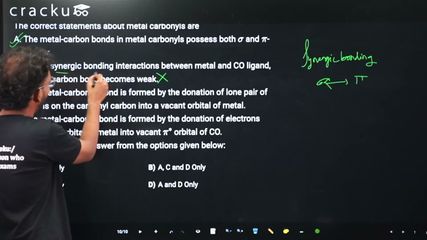
The correct statements about metal carbonyls are
A. The metal-carbon bonds in metal carbonyls possess both $$\sigma$$ and $$\pi$$-character.
B. Due to synergic bonding interactions between metal and CO ligand, the metal-carbon bond becomes weak.
C. The metal-carbon $$\sigma$$ bond is formed by the donation of lone pair of electrons on the carbonyl carbon into a vacant orbital of metal.
D. The metal-carbon $$\pi$$ bond is formed by the donation of electrons from filled d-orbital of metal into vacant $$\pi^*$$ orbital of CO.
Choose the correct answer from the options given below:
Synergic effect:
The $$\sigma\ $$-donation strengthens the $$\pi\ $$-back-donation, and the $$\pi\ $$-back-donation recursively strengthens the $$\sigma\ $$-donation. This cooperative interaction is known as a synergic effect, which, results in a stronger, highly stable metal-carbon bond.
Statement A is correct: The metal-carbon ($$M-C$$) bond in metal carbonyls exhibits a partial double-bond character because it has both $$\sigma\ $$ and $$\pi\ $$ character due to the simultaneous forward and backward electron donation.
Statement B is incorrect: The synergic bonding effect actually strengthens the metal-carbon bond while weakening the carbon-oxygen $$CO$$ bond.
Statement C is correct: The M-C $$\sigma\ $$ bond is formed through ligand-to-metal L$$\ \longrightarrow\ $$ M donation, where the lone pair of electrons on the carbonyl carbon is shared with a vacant $$d$$-orbital of the central transition metal.
Statement D is correct: The M-C $$\pi\ $$ bond is formed through metal-to-ligand M$$\ \longrightarrow\ $$ L back-donation, where electrons from a filled d-orbital of the metal shift into the empty antibonding $$\pi^*$$ orbital of the $$CO$$ ligand.
Hence, Option B $$\ \longrightarrow\ $$ A,C and D Only.
Was this solution helpful?
Click on the Email ☝️ to Watch the Video Solution
Create a FREE account and get:
_1.webp)

Educational materials for JEE preparation

Ask our AI anything

AI can make mistakes. Please verify important information.
AI can make mistakes. Please verify important information.


