
Join Our JEE Preparation Group
Prep with like-minded aspirants; Get access to free daily tests and study material.
Sign in
Please select an account to continue using cracku.in
↓ →
Join Our JEE Preparation Group
Prep with like-minded aspirants; Get access to free daily tests and study material.
The correct decreasing order of spin only magnetic moment values (BM) of $$Cu^+$$, $$Cu^{2+}$$, $$Cr^{2+}$$ and $$Cr^{3+}$$ ions is :
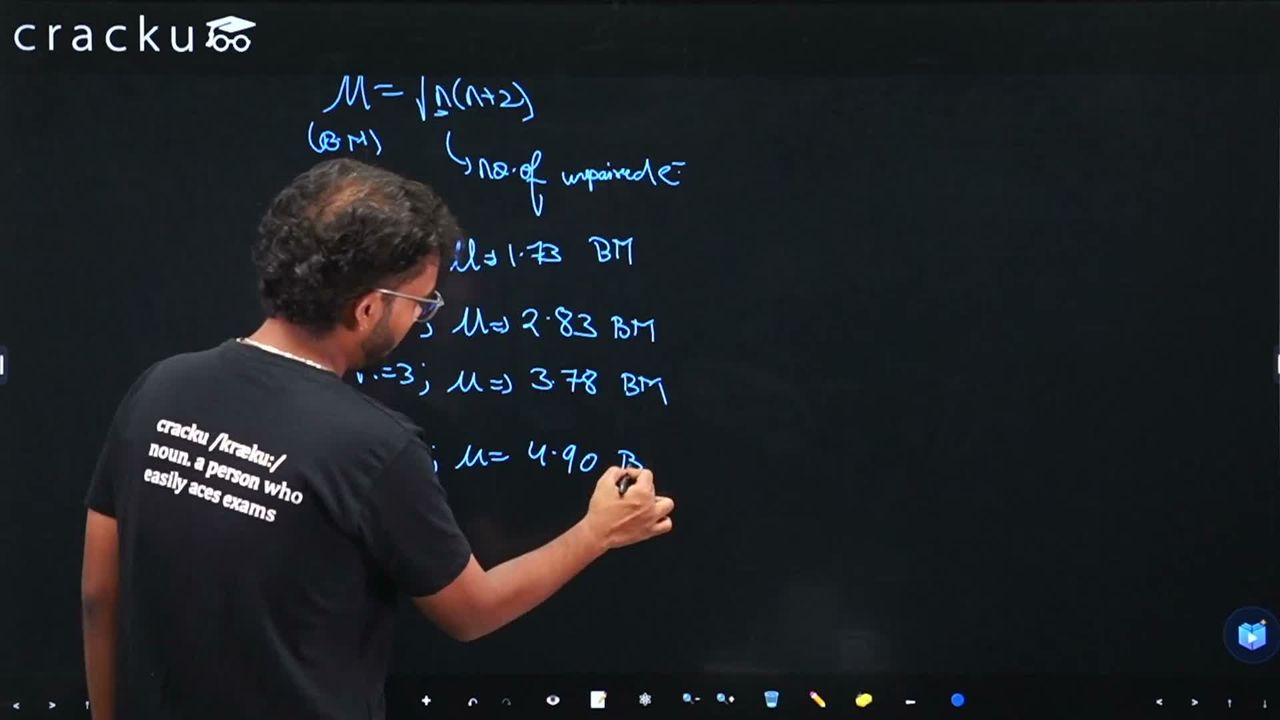
The spin-only magnetic moment of a transition-metal ion is calculated from
$$\mu_{s.o.}= \sqrt{n(n+2)}\;\text{BM}$$
where $$n$$ is the number of unpaired electrons in the ion.
First write the electronic configuration of each ion and count $$n$$.
Case 1: $$Cu^{+}\;(Z=29)$$
Neutral Cu : $$[Ar]\,3d^{10}\,4s^{1}$$
Removing one electron (from $$4s$$) gives $$Cu^{+} : [Ar]\,3d^{10}$$
All $$3d$$ electrons are paired ⇒ $$n = 0$$
$$\mu = \sqrt{0(0+2)} = 0\;\text{BM}$$
Case 2: $$Cu^{2+}$$
Remove one more electron (from $$3d$$) → $$Cu^{2+} : [Ar]\,3d^{9}$$
Configuration $$3d^{9} = 3d^{\uparrow\downarrow\,\uparrow\downarrow\,\uparrow\downarrow\,\uparrow\downarrow\,\uparrow}$$ ⇒ $$n = 1$$
$$\mu = \sqrt{1(1+2)} = \sqrt{3} \approx 1.73\;\text{BM}$$
Case 3: $$Cr^{2+}\;(Z = 24)$$
Neutral Cr : $$[Ar]\,3d^{5}\,4s^{1}$$
Removing two electrons (one from $$4s$$ and one from $$3d$$) gives
$$Cr^{2+} : [Ar]\,3d^{4}$$
All four $$3d$$ electrons are unpaired ⇒ $$n = 4$$
$$\mu = \sqrt{4(4+2)} = \sqrt{24} \approx 4.90\;\text{BM}$$
Case 4: $$Cr^{3+}$$
Remove one more electron from $$3d$$ → $$Cr^{3+} : [Ar]\,3d^{3}$$
All three $$3d$$ electrons are unpaired ⇒ $$n = 3$$
$$\mu = \sqrt{3(3+2)} = \sqrt{15} \approx 3.87\;\text{BM}$$
Arrange the magnetic moments in decreasing order:
$$Cr^{2+}\;(4.90\;{\rm BM}) \gt Cr^{3+}\;(3.87\;{\rm BM}) \gt Cu^{2+}\;(1.73\;{\rm BM}) \gt Cu^{+}\;(0\;{\rm BM})$$
Therefore the correct decreasing order is
$$Cr^{2+} \gt Cr^{3+} \gt Cu^{2+} \gt Cu^{+}$$
Matching with the given options, this is Option C.
Was this solution helpful?
Click on the Email ☝️ to Watch the Video Solution
Create a FREE account and get:
_1.webp)

Educational materials for JEE preparation

Ask our AI anything

AI can make mistakes. Please verify important information.
AI can make mistakes. Please verify important information.
