
Join Our JEE Preparation Group
Prep with like-minded aspirants; Get access to free daily tests and study material.
Sign in
Please select an account to continue using cracku.in
↓ →
Join Our JEE Preparation Group
Prep with like-minded aspirants; Get access to free daily tests and study material.
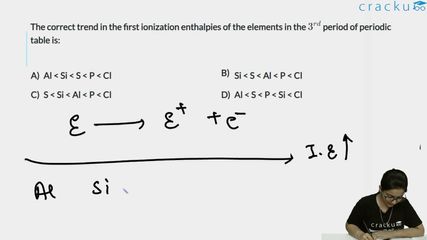
The correct trend in the first ionization enthalpies of the elements in the $$3^{rd}$$ period of periodic table is:
The elements present in the $$3^{rd}$$ period are $$Na, Mg, Al, Si, P, S, Cl, Ar$$.
First ionization enthalpy (IE$$_1$$) generally increases from left to right across a period because
- atomic size decreases, and
- effective nuclear charge $$Z_{\text{eff}}$$ increases.
There are two characteristic exceptions in this period:
Case 1: $$Mg \gt Al$$ because $$Mg$$ has the stable configuration $$3s^{2}$$, whereas in $$Al$$ the electron is removed from the higher-energy $$3p^{1}$$ subshell, so less energy is needed.
Case 2: $$P \gt S$$ because $$P$$ possesses the half-filled configuration $$3p^{3}$$, which is more stable than the $$3p^{4}$$ configuration of $$S$$. Hence an electron is removed more easily from $$S$$.
Experimental IE$$_1$$ values (in $$\text{kJ mol}^{-1}$$) confirm this trend:
$$IE_1(Na)=496 \lt IE_1(Mg)=738 \gt IE_1(Al)=578 \lt IE_1(Si)=787 \lt IE_1(S)=999 \lt IE_1(P)=1012 \lt IE_1(Cl)=1251 \lt IE_1(Ar)=1521$$.
Keeping only the elements quoted in the options and arranging them in ascending order:
$$Al \lt Si \lt S \lt P \lt Cl$$
This sequence corresponds to Option A.
Hence, the correct trend in first ionization enthalpies for the given elements of the $$3^{rd}$$ period is $$Al \lt Si \lt S \lt P \lt Cl$$; the correct answer is Option A.
Was this solution helpful?
Click on the Email ☝️ to Watch the Video Solution
Create a FREE account and get:
Educational materials for JEE preparation

Ask our AI anything

AI can make mistakes. Please verify important information.
AI can make mistakes. Please verify important information.

_1.webp)
