
Join Our JEE Preparation Group
Prep with like-minded aspirants; Get access to free daily tests and study material.
Sign in
Please select an account to continue using cracku.in
↓ →
Join Our JEE Preparation Group
Prep with like-minded aspirants; Get access to free daily tests and study material.
If $$\int_{}^{}e^{x}\left(\frac{x\sin^{-1}x}{\sqrt{1-x^{2}}}+\frac{sin^{-1}x}{(1-x^{2})^{3/2}}+\frac{x}{1-x^{2}}\right)dx=g(x)+C$$ where C is the constant of integration, then $$g(\frac{1}{2})$$ equals
The given integral is:
$$\int e^{x} \left( \frac{x \sin^{-1} x}{\sqrt{1-x^{2}}} + \frac{\sin^{-1} x}{(1-x^{2})^{3/2}} + \frac{x}{1-x^{2}} \right) dx = g(x) + C$$
The integrand is of the form $$e^x h(x)$$, where:
$$h(x) = \frac{x \sin^{-1} x}{\sqrt{1-x^{2}}} + \frac{\sin^{-1} x}{(1-x^{2})^{3/2}} + \frac{x}{1-x^{2}}$$
This suggests that $$h(x)$$ might be expressible as $$f(x) + f'(x)$$ for some function $$f(x)$$, because the integral of $$e^x [f(x) + f'(x)]$$ is $$e^x f(x) + C$$.
Assume $$f(x) = \sin^{-1} x \cdot g(x)$$, so:
$$f'(x) = \frac{d}{dx} (\sin^{-1} x) \cdot g(x) + \sin^{-1} x \cdot g'(x) = \frac{g(x)}{\sqrt{1-x^2}} + \sin^{-1} x \cdot g'(x)$$
$$f(x) + f'(x) = \sin^{-1} x \cdot g(x) + \frac{g(x)}{\sqrt{1-x^2}} + \sin^{-1} x \cdot g'(x) = \sin^{-1} x \left( g(x) + g'(x) \right) + \frac{g(x)}{\sqrt{1-x^2}}$$
Set this equal to $$h(x)$$:
$$\sin^{-1} x \left( g(x) + g'(x) \right) + \frac{g(x)}{\sqrt{1-x^2}} = \frac{x \sin^{-1} x}{\sqrt{1-x^{2}}} + \frac{\sin^{-1} x}{(1-x^{2})^{3/2}} + \frac{x}{1-x^{2}}$$
Equate the coefficients of $$\sin^{-1} x$$ and the remaining terms:
1. $$g(x) + g'(x) = \frac{x}{\sqrt{1-x^{2}}} + \frac{1}{(1-x^{2})^{3/2}}$$
2. $$\frac{g(x)}{\sqrt{1-x^2}} = \frac{x}{1-x^{2}}$$
Solve equation (2) for $$g(x)$$:
$$\frac{g(x)}{\sqrt{1-x^2}} = \frac{x}{1-x^{2}} = \frac{x}{(1-x^2)}$$
Multiply both sides by $$\sqrt{1-x^2}$$:
$$g(x) = \frac{x}{\sqrt{1-x^2}} \cdot \sqrt{1-x^2} \cdot \frac{1}{\sqrt{1-x^2}} \cdot \sqrt{1-x^2} = x \cdot (1-x^2)^{-1} \cdot (1-x^2)^{1/2} = x (1-x^2)^{-1/2}$$
$$g(x) = \frac{x}{\sqrt{1-x^2}}$$
Verify equation (1) with this $$g(x)$$:
$$g'(x) = \frac{d}{dx} \left( x (1-x^2)^{-1/2} \right) = (1) \cdot (1-x^2)^{-1/2} + x \cdot \left( -\frac{1}{2} \right) (1-x^2)^{-3/2} \cdot (-2x) = (1-x^2)^{-1/2} + x^2 (1-x^2)^{-3/2}$$
$$g(x) + g'(x) = \frac{x}{\sqrt{1-x^2}} + \frac{1}{\sqrt{1-x^2}} + \frac{x^2}{(1-x^2)^{3/2}} = \frac{x}{\sqrt{1-x^2}} + \frac{1-x^2}{(1-x^2)^{3/2}} + \frac{x^2}{(1-x^2)^{3/2}} = \frac{x}{\sqrt{1-x^2}} + \frac{1}{(1-x^2)^{3/2}}$$
This matches equation (1).
Thus, $$f(x) = \sin^{-1} x \cdot g(x) = \sin^{-1} x \cdot \frac{x}{\sqrt{1-x^2}}$$.
The integral is:
$$\int e^x h(x) dx = \int e^x [f(x) + f'(x)] dx = e^x f(x) + C = e^x \cdot \sin^{-1} x \cdot \frac{x}{\sqrt{1-x^2}} + C$$
$$g(x) = e^x \cdot x \cdot \sin^{-1} x \cdot (1-x^2)^{-1/2}$$
Now compute $$g\left(\frac{1}{2}\right)$$:
- $$x = \frac{1}{2}$$
- $$\sin^{-1}\left(\frac{1}{2}\right) = \frac{\pi}{6}$$
- $$\sqrt{1 - \left(\frac{1}{2}\right)^2} = \sqrt{1 - \frac{1}{4}} = \sqrt{\frac{3}{4}} = \frac{\sqrt{3}}{2}$$
- $$(1-x^2)^{-1/2} = \frac{1}{\frac{\sqrt{3}}{2}} = \frac{2}{\sqrt{3}}$$
- $$e^x = e^{1/2} = \sqrt{e}$$
$$g\left(\frac{1}{2}\right) = \sqrt{e} \cdot \frac{1}{2} \cdot \frac{\pi}{6} \cdot \frac{2}{\sqrt{3}} = \sqrt{e} \cdot \frac{1}{2} \cdot \frac{2}{\sqrt{3}} \cdot \frac{\pi}{6} = \sqrt{e} \cdot 1 \cdot \frac{\pi}{6} \cdot \frac{1}{\sqrt{3}} = \frac{\pi}{6} \cdot \frac{\sqrt{e}}{\sqrt{3}} = \frac{\pi}{6} \sqrt{\frac{e}{3}}$$
This matches option B.
Was this solution helpful?
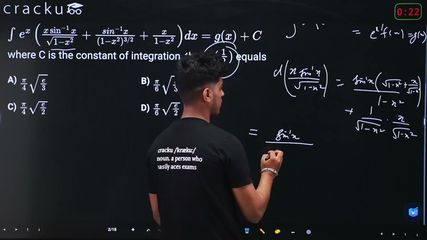
Click on the Email ☝️ to Watch the Video Solution
Create a FREE account and get:
_1.webp)

Educational materials for JEE preparation

Ask our AI anything

AI can make mistakes. Please verify important information.
AI can make mistakes. Please verify important information.
