
Join Our JEE Preparation Group
Prep with like-minded aspirants; Get access to free daily tests and study material.
Sign in
Please select an account to continue using cracku.in
↓ →
Join Our JEE Preparation Group
Prep with like-minded aspirants; Get access to free daily tests and study material.
Given below are two statements:
Statement I: If $$E$$ be the total energy of a satellite moving around the earth, then its potential energy will be $$\dfrac{E}{2}$$.
Statement II: The kinetic energy of a satellite revolving in an orbit is equal to the half the magnitude of total energy $$E$$.
In the light of the above statements, choose the most appropriate answer from the options given below.
We need to evaluate two statements about satellite energy.
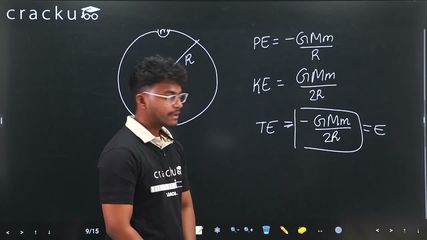
Recall the energy relations for a satellite in orbit. For a satellite of mass $$m$$ orbiting Earth at radius $$r$$:
- Kinetic Energy: $$KE = \frac{GMm}{2r}$$
- Potential Energy: $$PE = -\frac{GMm}{r}$$
- Total Energy: $$E = KE + PE = -\frac{GMm}{2r}$$
Note that $$E$$ is negative.
Check Statement I — "PE = E/2": $$E/2 = -\frac{GMm}{4r}$$
But $$PE = -\frac{GMm}{r}$$
Since $$PE \neq E/2$$ (in fact, $$PE = 2E$$), Statement I is incorrect.
Check Statement II — "KE = |E|/2": $$|E| = \frac{GMm}{2r}$$
$$|E|/2 = \frac{GMm}{4r}$$
But $$KE = \frac{GMm}{2r} = |E|$$
Since $$KE = |E| \neq |E|/2$$, Statement II is incorrect.
The correct relationships are: $$PE = 2E$$ and $$KE = -E = |E|$$.
Since both statements are incorrect, the correct answer is Option D: Both Statement I and Statement II are incorrect.
Was this solution helpful?
Click on the Email ☝️ to Watch the Video Solution
Create a FREE account and get:
_1.webp)

Educational materials for JEE preparation

Ask our AI anything

AI can make mistakes. Please verify important information.
AI can make mistakes. Please verify important information.
