
Join Our JEE Preparation Group
Prep with like-minded aspirants; Get access to free daily tests and study material.
Sign in
Please select an account to continue using cracku.in
↓ →
Join Our JEE Preparation Group
Prep with like-minded aspirants; Get access to free daily tests and study material.
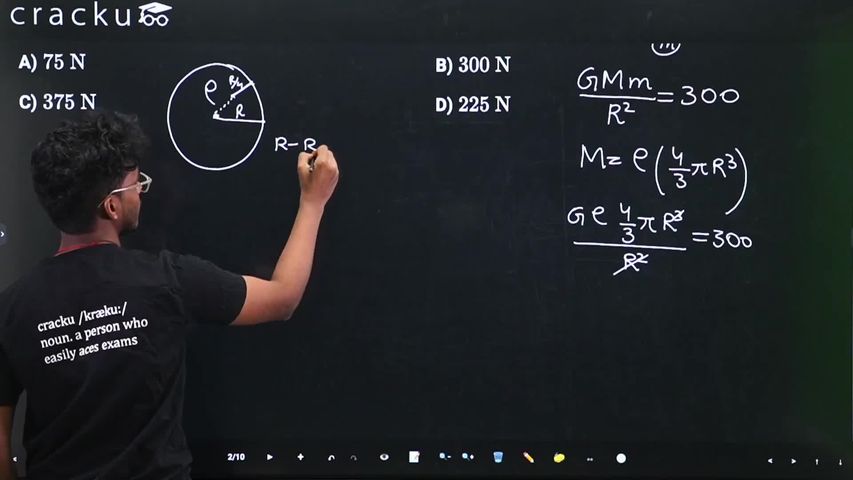
Assuming the earth to be a sphere of uniform mass density, a body weighed $$300 \text{ N}$$ on the surface of earth. How much it would weigh at $$R/4$$ depth under surface of earth?
We need to find the weight of a body at a depth of $$R/4$$ below the Earth's surface, given that it weighs 300 N on the surface.
We know that the acceleration due to gravity at a depth $$d$$ below the Earth's surface (assuming uniform density) is $$g' = g\left(1 - \frac{d}{R}\right)$$, where $$g$$ is the acceleration due to gravity at the surface and $$R$$ is the radius of the Earth. This formula arises because at depth $$d$$, only the spherical shell of radius $$(R - d)$$ contributes to the gravitational field (by the shell theorem, the outer shell exerts no net force).
Substituting $$d = R/4$$ into this expression gives $$g' = g\left(1 - \frac{R/4}{R}\right) = g\left(1 - \frac{1}{4}\right) = g \times \frac{3}{4}$$.
Therefore, the weight of the body at this depth is $$W' = m \times g' = m \times \frac{3g}{4}$$.
Since the surface weight is $$W = mg = 300 \,\text{N}$$, it follows that $$W' = \frac{3}{4} \times W = \frac{3}{4} \times 300 = 225 \,\text{N}$$.
The correct answer is Option (4): 225 N.
Was this solution helpful?
Click on the Email ☝️ to Watch the Video Solution
Create a FREE account and get:
_1.webp)

Educational materials for JEE preparation

Ask our AI anything

AI can make mistakes. Please verify important information.
AI can make mistakes. Please verify important information.
