
Join Our JEE Preparation Group
Prep with like-minded aspirants; Get access to free daily tests and study material.
Sign in
Please select an account to continue using cracku.in
↓ →
Join Our JEE Preparation Group
Prep with like-minded aspirants; Get access to free daily tests and study material.
A body is projected vertically upwards from the surface of earth with a velocity sufficient enough to carry it to infinity. The time taken by it to reach height $$h$$ is ___ s.
A body projected with escape velocity satisfies the energy equation at any height $$r$$ from the Earth's center: $$\frac{1}{2}mv^2 - \frac{GMm}{r} = 0$$ so $$v = \sqrt{\frac{2GM}{r}}$$.
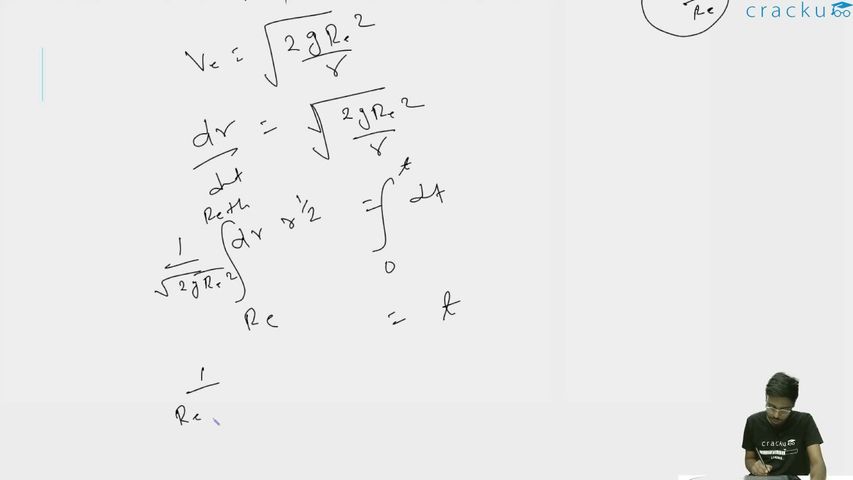
Using $$GM = gR_e^2$$, we get $$v = \frac{dr}{dt} = \sqrt{\frac{2gR_e^2}{r}}$$.
Separating variables: $$\sqrt{r}\, dr = \sqrt{2gR_e^2}\, dt = R_e\sqrt{2g}\, dt$$
Integrating from $$r = R_e$$ to $$r = R_e + h$$: $$\int_{R_e}^{R_e+h} r^{1/2}\, dr = R_e\sqrt{2g} \int_0^t dt$$
$$\left[\frac{2}{3}r^{3/2}\right]_{R_e}^{R_e+h} = R_e\sqrt{2g}\cdot t$$
$$\frac{2}{3}\left[(R_e+h)^{3/2} - R_e^{3/2}\right] = R_e\sqrt{2g}\cdot t$$
$$t = \frac{2}{3R_e\sqrt{2g}}\left[(R_e+h)^{3/2} - R_e^{3/2}\right]$$
Factoring out $$R_e^{3/2}$$: $$t = \frac{2R_e^{3/2}}{3R_e\sqrt{2g}}\left[\left(1+\frac{h}{R_e}\right)^{3/2} - 1\right] = \frac{2\sqrt{R_e}}{3\sqrt{2g}}\left[\left(1+\frac{h}{R_e}\right)^{3/2} - 1\right]$$
Simplifying: $$t = \frac{1}{3}\sqrt{\frac{2R_e}{g}}\left[\left(1+\frac{h}{R_e}\right)^{3/2} - 1\right]$$
This matches option 4.
Was this solution helpful?
Click on the Email ☝️ to Watch the Video Solution
Create a FREE account and get:
_1.webp)

Educational materials for JEE preparation

Ask our AI anything

AI can make mistakes. Please verify important information.
AI can make mistakes. Please verify important information.
