
Join Our JEE Preparation Group
Prep with like-minded aspirants; Get access to free daily tests and study material.
Sign in
Please select an account to continue using cracku.in
↓ →
Join Our JEE Preparation Group
Prep with like-minded aspirants; Get access to free daily tests and study material.
The angle of elevation of the summit of a mountain from a point on the ground is $$45^\circ$$. After climbing up one km towards the summit at an inclination of $$30^\circ$$ from the ground, the angle of elevation of the summit is found to be $$60^\circ$$. Then the height (in km) of the summit from the ground is:
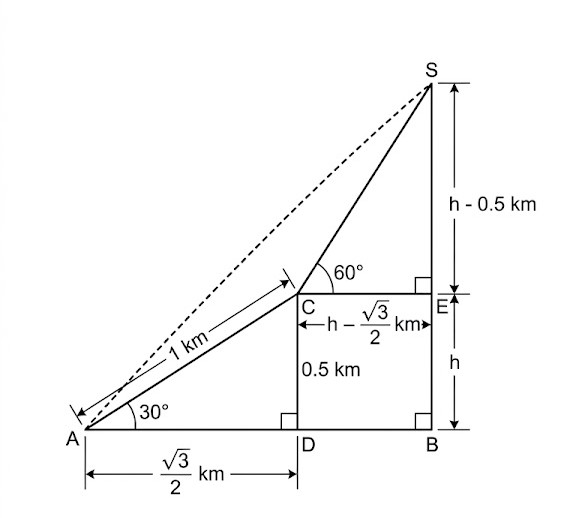
Let us denote the foot of the mountain by point $$B$$, the first observation point on the ground by $$A$$ and the summit of the mountain by $$S$$. We are asked to find the height $$BS$$ (in km) of the mountain.
We first translate the given angles into the language of right-angle trigonometry. From point $$A$$ the angle of elevation of the summit is $$45^\circ$$. Using the definition of the tangent function,
$$\tan 45^\circ \;=\;\frac{\text{opposite side}}{\text{adjacent side}} \;=\;\frac{BS}{AB}.$$
Because $$\tan 45^\circ = 1$$, we obtain the simple relation
$$BS = AB.$$
We now move from $$A$$ a distance of exactly $$1\text{ km}$$ towards the summit along a path that is inclined at $$30^\circ$$ to the horizontal. Let the new point reached on this path be $$C$$. Since the traveller is going “towards the summit”, the path $$AC$$ lies in the plane containing $$AB$$ and $$BS$$. From elementary resolution of a line segment inclined at $$30^\circ$$ we get:
vertical rise from $$A$$ to $$C$$: $$AC \sin 30^\circ = 1 \times \frac12 = 0.5\text{ km},$$
horizontal advance (towards the foot $$B$$): $$AC \cos 30^\circ = 1 \times \frac{\sqrt3}{2} = \frac{\sqrt3}{2}\text{ km}.$$
Hence the height of point $$C$$ above the ground is
$$\text{height of }C = 0.5\text{ km},$$
and the remaining vertical distance from $$C$$ to the summit is
$$SC = BS - 0.5\text{ km}.$$
Meanwhile the horizontal distance from point $$C$$ to the foot $$B$$ has decreased by $$\dfrac{\sqrt3}{2}\text{ km}$$, so it is now
$$BC = AB - \frac{\sqrt3}{2}\text{ km}.$$
But we already know $$AB = BS$$, so
$$BC = BS - \frac{\sqrt3}{2}.$$
From point $$C$$ the angle of elevation of the summit is stated to be $$60^\circ$$. Applying the tangent definition once more, this time in right-angled triangle $$B C S$$, we have
$$\tan 60^\circ = \frac{\text{opposite side}}{\text{adjacent side}} = \frac{SC}{BC} = \frac{BS - 0.5}{\,BS - \dfrac{\sqrt3}{2}\,}.$$
Because $$\tan 60^\circ = \sqrt3$$, we write
$$\sqrt3 = \frac{BS - 0.5}{BS - \dfrac{\sqrt3}{2}}.$$
To remove the denominator, we cross-multiply:
$$\sqrt3\Bigl(BS - \frac{\sqrt3}{2}\Bigr) = BS - 0.5.$$
Expanding the left-hand side gives
$$\sqrt3\,BS - \sqrt3\!\left(\frac{\sqrt3}{2}\right) = BS - 0.5,$$
and since $$\sqrt3 \times \sqrt3 = 3$$, this becomes
$$\sqrt3\,BS - \frac{3}{2} = BS - 0.5.$$
Now we gather the $$BS$$ terms on one side and the constants on the other side:
$$\sqrt3\,BS - BS = \frac{3}{2} - 0.5.$$
The right-hand constant simplifies because $$0.5 = \dfrac{1}{2}$$, so
$$\sqrt3\,BS - BS = \frac{3}{2} - \frac{1}{2} = 1.$$
Factoring $$BS$$ out of the left-hand side, we obtain
$$(\sqrt3 - 1)\,BS = 1.$$
Finally we solve for $$BS$$ (the required height):
$$BS = \frac{1}{\sqrt3 - 1}.$$
This expression exactly matches Option C given in the problem statement. Hence, the correct answer is Option C.
Was this solution helpful?
Click on the Email ☝️ to Watch the Video Solution
Create a FREE account and get:
_1.webp)

Educational materials for JEE preparation

Ask our AI anything

AI can make mistakes. Please verify important information.
AI can make mistakes. Please verify important information.


