
Join Our JEE Preparation Group
Prep with like-minded aspirants; Get access to free daily tests and study material.
Sign in
Please select an account to continue using cracku.in
↓ →
Join Our JEE Preparation Group
Prep with like-minded aspirants; Get access to free daily tests and study material.
Which of the following statement(s) is incorrect?
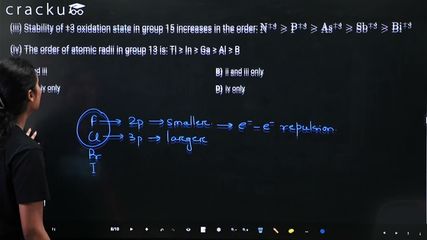
(i) The order of electron gain enthalpy for halogens is: Cl > F > Br >I
(ii) The first ionization energy follows the order: C < O < N <F
(iii) Stability of +3 oxidation state in group 15 increases in the order: $$\mathrm{N^{+3} > P^{+3} > As^{+3} > Sb^{+3} > Bi^{+3}}$$
(iv) The order of atomic radii in group 13 is: Tl > In > Ga > Al > B
(i) Halogen Electron Gain Enthalpy: Cl > F > Br > I
The Trend: Generally, electron gain enthalpy decreases down the group as atomic size increases. Fluorine is exceptionally small, so its 2p electron cloud is highly compact. The incoming electron experiences strong inter-electronic repulsion in the compact 2p orbital of Fluorine. Chlorine has a larger 3p orbital, so the incoming electron experiences less repulsion and more energy is released.
(ii) First Ionization Energy: C < O < N < F
First ionization energy generally increases from left to right across a period due to increasing nuclear charge. Nitrogen has a higher ionization energy than Oxygen as it has half-filled stable electronic configuration and hence, it requires more energy to remove electron from nitrogen.
(iii) Why it is incorrect:
Fact: In Group 15, the stability of the +3 oxidation state increases down the group due to the inert pair effect (the reluctance of the outermost s-orbital electrons to participate in bonding).
Correct Order: $$\mathrm{N^{+3} < P^{+3} < As^{+3} < Sb^{+3} < Bi^{+3}}$$
(iv) Why it is incorrect:
Fact: Due to the d-block contraction (poor shielding effect of the filled 3d orbital electrons in Gallium), the atomic radius of Gallium ($$\mathrm{Ga}$$) is unexpectedly smaller than that of Aluminium ($$\mathrm{Al}$$).
Correct Order: $$\mathrm{Tl>In>Al>Ga>B}$$
Correct option: (C)
Was this solution helpful?
Click on the Email ☝️ to Watch the Video Solution
Create a FREE account and get:
_1.webp)

Educational materials for JEE preparation

Ask our AI anything

AI can make mistakes. Please verify important information.
AI can make mistakes. Please verify important information.
