
Join Our JEE Preparation Group
Prep with like-minded aspirants; Get access to free daily tests and study material.
Sign in
Please select an account to continue using cracku.in
↓ →
Join Our JEE Preparation Group
Prep with like-minded aspirants; Get access to free daily tests and study material.
The solubility product of a sparingly soluble salt $$A_2X_3$$ is $$1.1 \times 10^{-23}$$. If specific conductance of the solution is $$x \times 10^{-3}$$ S m$$^2$$ mol$$^{-1}$$. The value of $$x$$ is ______
Correct Answer: 3
We are given that the solubility product of $$A_2X_3$$ is $$K_{sp} = 1.1 \times 10^{-23}$$ and the specific conductance of the saturated solution is $$\kappa = 3 \times 10^{-5}$$ S m$$^{-1}$$. We need to find the limiting molar conductivity expressed as $$x \times 10^{-3}$$ S m$$^2$$ mol$$^{-1}$$.
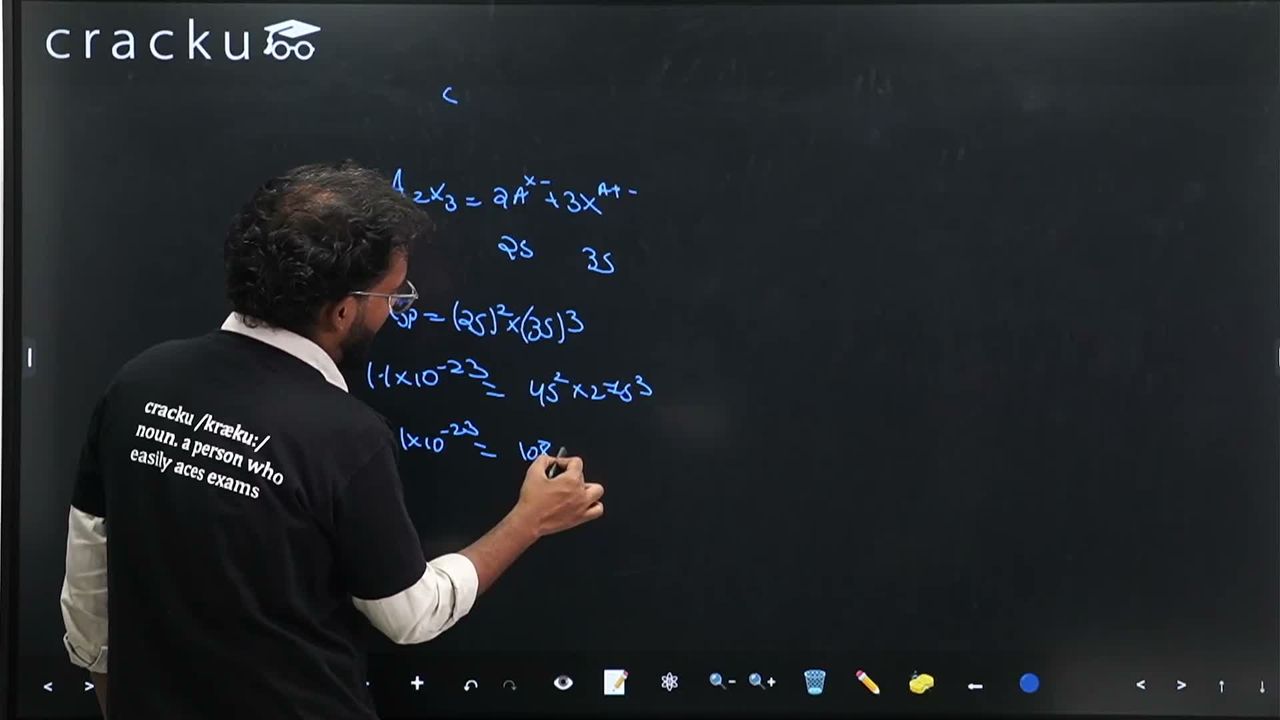
The salt dissociates as $$A_2X_3 \rightarrow 2A^{3+} + 3X^{2-}$$. If the molar solubility is $$s$$, then $$[A^{3+}] = 2s$$ and $$[X^{2-}] = 3s$$.
Writing the solubility product: $$K_{sp} = (2s)^2(3s)^3 = 4s^2 \times 27s^3 = 108\,s^5$$.
Solving: $$s^5 = \frac{1.1 \times 10^{-23}}{108} \approx 1.019 \times 10^{-25}$$.
Taking the fifth root: $$(10^{-25})^{1/5} = 10^{-5}$$ and $$(1.019)^{1/5} \approx 1$$, so $$s \approx 10^{-5}$$ mol L$$^{-1}$$.
Converting to mol m$$^{-3}$$: $$s = 10^{-5} \times 10^3 = 10^{-2}$$ mol m$$^{-3}$$.
The molar conductivity is $$\Lambda_m = \frac{\kappa}{c} = \frac{3 \times 10^{-5}}{10^{-2}} = 3 \times 10^{-3}$$ S m$$^2$$ mol$$^{-1}$$.
So, the answer is $$3$$.
Was this solution helpful?
Click on the Email ☝️ to Watch the Video Solution
Create a FREE account and get:
_1.webp)

Educational materials for JEE preparation

Ask our AI anything

AI can make mistakes. Please verify important information.
AI can make mistakes. Please verify important information.
