
Join Our JEE Preparation Group
Prep with like-minded aspirants; Get access to free daily tests and study material.
Sign in
Please select an account to continue using cracku.in
↓ →
Join Our JEE Preparation Group
Prep with like-minded aspirants; Get access to free daily tests and study material.
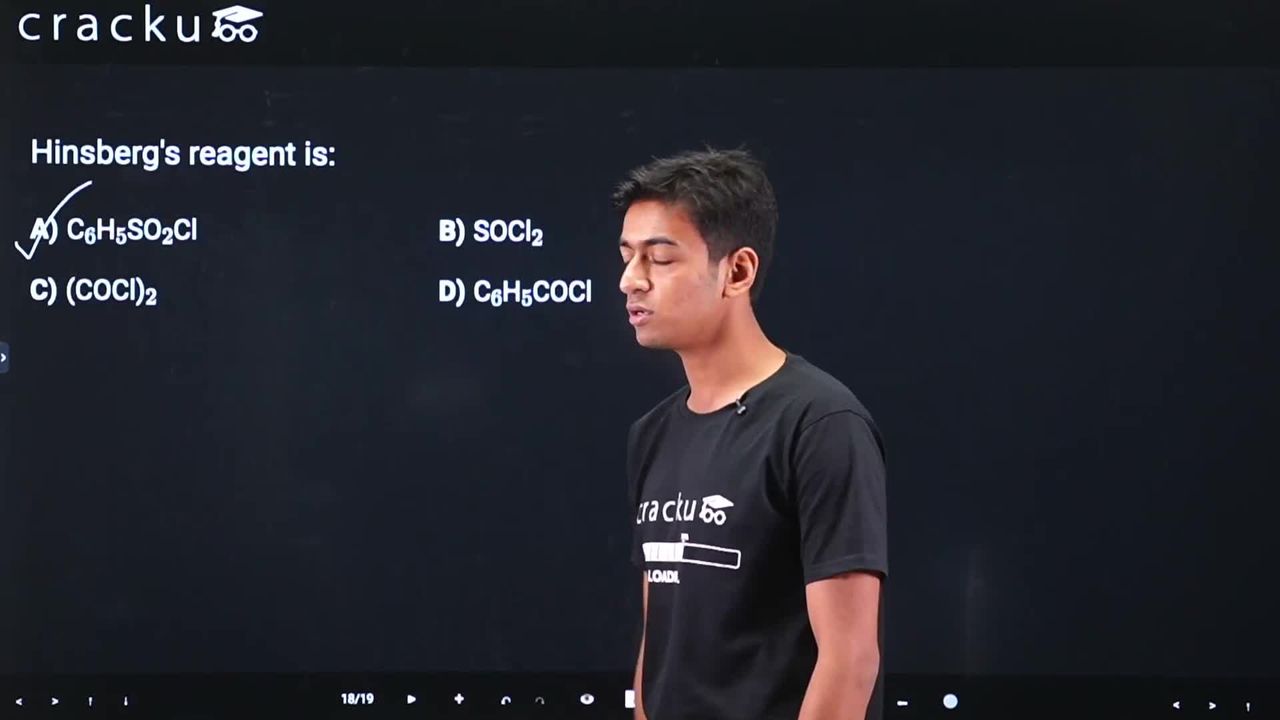
We begin by recalling the definition that “Hinsberg’s reagent” is a specific sulfonyl chloride used in the Hinsberg test for distinguishing primary, secondary and tertiary amines. The textbook name of this reagent is benzenesulfonyl chloride.
Writing its molecular formula, we have
$$\mathrm{C_6H_5SO_2Cl}$$
This reagent reacts with an amine inside a basic medium to form a sulfonamide, the solubility of which helps us identify the class of the amine. Since the reagent required for this test must possess the sulfonyl chloride group $$\mathrm{-SO_2Cl}$$ attached to a benzene ring, only one of the given options matches this condition.
Looking at the four choices:
A. $$\mathrm{C_6H_5SO_2Cl} \;(\text{benzenesulfonyl chloride})$$
B. $$\mathrm{SOCl_2} \;(\text{thionyl chloride})$$
C. $$(\mathrm{COCl})_2 \;(\text{oxalyl chloride})$$
D. $$\mathrm{C_6H_5COCl} \;(\text{benzoyl chloride})$$
Only option A possesses the required $$\mathrm{-SO_2Cl}$$ functional group attached directly to the benzene ring, making it the correct Hinsberg reagent.
Hence, the correct answer is Option A.
Was this solution helpful?
Click on the Email ☝️ to Watch the Video Solution
Create a FREE account and get:
_1.webp)

Educational materials for JEE preparation

Ask our AI anything

AI can make mistakes. Please verify important information.
AI can make mistakes. Please verify important information.


