
Join Our JEE Preparation Group
Prep with like-minded aspirants; Get access to free daily tests and study material.
Sign in
Please select an account to continue using cracku.in
↓ →
Join Our JEE Preparation Group
Prep with like-minded aspirants; Get access to free daily tests and study material.
Given below are two statements:
Statement I: The Henry's law constant $$K_{H}$$ is constant with respect to variations in solution's concentration over the range for which the solution is ideally dilute.
Statement II: $$K_{H}$$ does not differ for the same solute in different solvents.
In the light of the above statements, choose the correct answer from the options given below
Henry's law states that the partial pressure of a gas ($$P$$) above a solution is proportional to the mole fraction of the gas dissolved in the solution ($$x$$) at a constant temperature. The mathematical form is $$P = K_H \cdot x$$, where $$K_H$$ is the Henry's law constant.
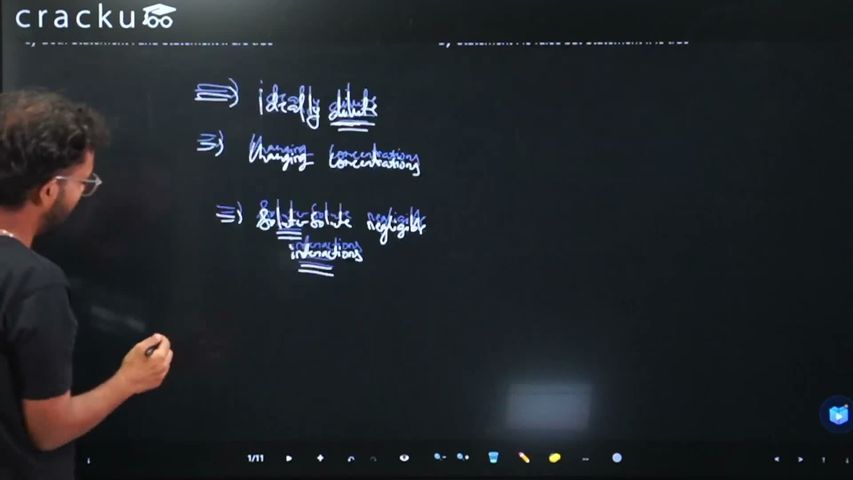
Statement I claims that $$K_H$$ is constant with respect to concentration variations in an ideally dilute solution. In an ideally dilute solution, the solute-solute interactions are negligible, and Henry's law holds strictly. Therefore, $$K_H$$ remains constant for a given gas-solvent pair at a fixed temperature over the range where the solution is dilute. Hence, Statement I is true.
Statement II claims that $$K_H$$ does not differ for the same solute in different solvents. However, $$K_H$$ depends on the nature of the solvent because the solubility of a gas varies with the solvent. For example, the same gas (like oxygen) has different $$K_H$$ values in water versus ethanol due to different intermolecular interactions. Thus, Statement II is false.
Therefore, Statement I is true, but Statement II is false.
The correct option is A.
Was this solution helpful?
Click on the Email ☝️ to Watch the Video Solution
Create a FREE account and get:
_1.webp)

Educational materials for JEE preparation

Ask our AI anything

AI can make mistakes. Please verify important information.
AI can make mistakes. Please verify important information.
