
Join Our JEE Preparation Group
Prep with like-minded aspirants; Get access to free daily tests and study material.
Sign in
Please select an account to continue using cracku.in
↓ →
Join Our JEE Preparation Group
Prep with like-minded aspirants; Get access to free daily tests and study material.
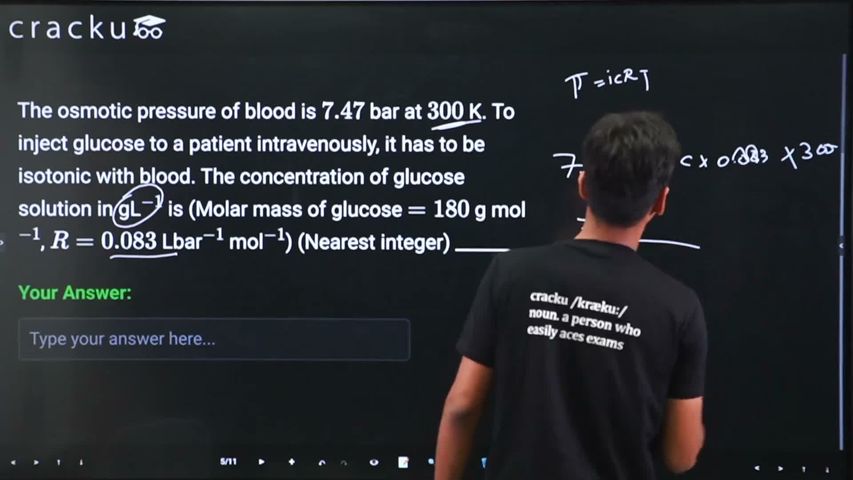
The osmotic pressure of blood is $$7.47$$ bar at $$300$$ K. To inject glucose to a patient intravenously, it has to be isotonic with blood. The concentration of glucose solution in gL$$^{-1}$$ is (Molar mass of glucose $$= 180$$ g mol$$^{-1}$$, $$R = 0.083$$ Lbar$$^{-1}$$ mol$$^{-1}$$) (Nearest integer) ______
Correct Answer: 54
We need to find the concentration of glucose solution (in g/L) that is isotonic with blood. For isotonic solutions, the osmotic pressure of the glucose solution must equal the osmotic pressure of blood.
The formula for osmotic pressure is:
$$ \pi = CRT $$
where $$\pi$$ is the osmotic pressure, $$C$$ is the molar concentration (mol/L), $$R$$ is the gas constant, and $$T$$ is the temperature in Kelvin.
With $$\pi = 7.47$$ bar, $$T = 300$$ K, and $$R = 0.083$$ L bar$$^{-1}$$ mol$$^{-1}$$, we solve for the molar concentration $$C$$ as follows:
$$ C = \frac{\pi}{RT} = \frac{7.47}{0.083 \times 300} $$
$$ C = \frac{7.47}{24.9} = 0.3 \text{ mol/L} $$
Converting molar concentration to g/L using the molar mass of glucose ($$M = 180$$ g/mol):
$$ \text{Concentration (g/L)} = C \times M = 0.3 \times 180 $$
$$ \text{Concentration (g/L)} = 54 $$
Therefore, the concentration of glucose solution is 54 g/L.
Was this solution helpful?
Click on the Email ☝️ to Watch the Video Solution
Create a FREE account and get:
_1.webp)

Educational materials for JEE preparation

Ask our AI anything

AI can make mistakes. Please verify important information.
AI can make mistakes. Please verify important information.
